
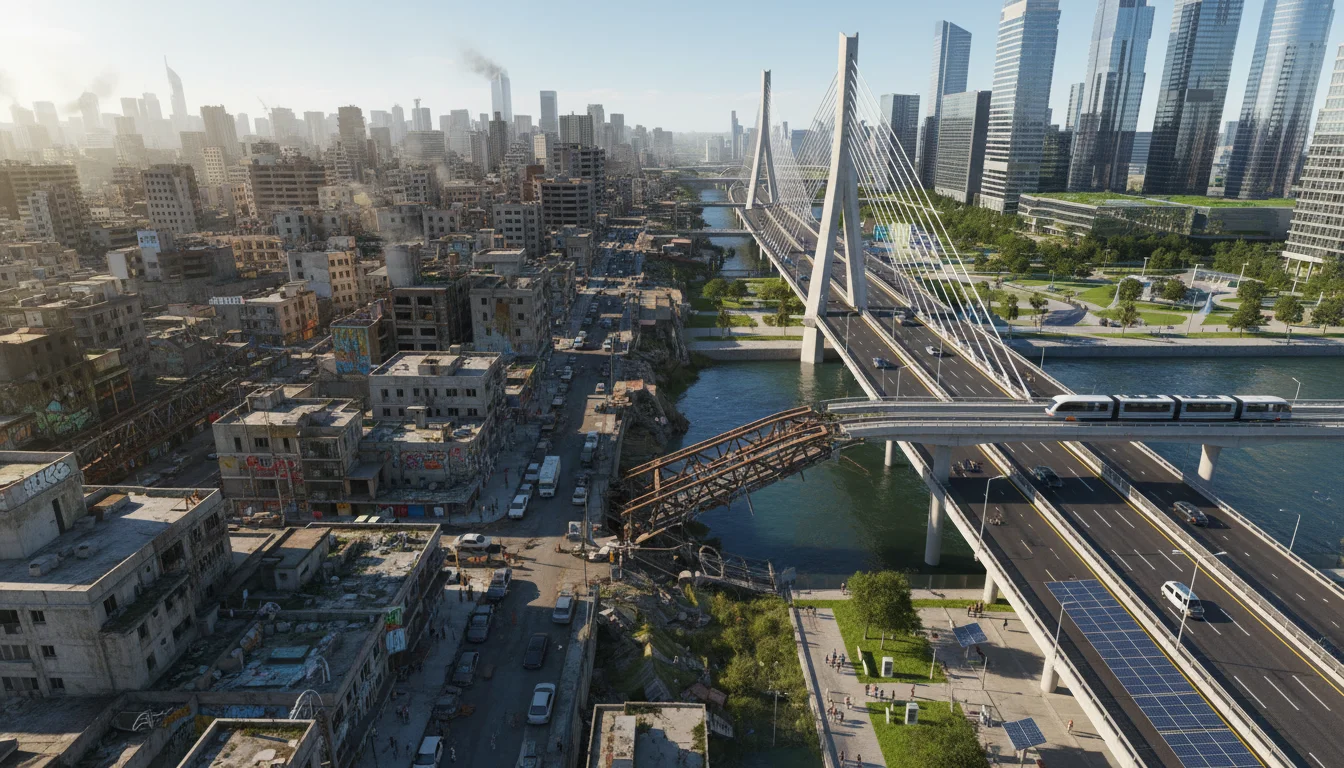

The debate is raging in the world of urban planning: should we prioritize the quantity of infrastructure or focus on its quality? This is a crucial question that goes beyond mere figures, directly impacting everyone’s daily life. We realize that the choices made today profoundly affect our ability to move around, to work, to access healthcare, or even to breathe clean air. Infrastructure, whether roads, digital networks, energy, or public services, is much more than concrete and cables. It is the beating heart of our regions, the engine of our development, and the cement of our social cohesion. Clearly, the balance between extensive networks and robust infrastructure is a constant challenge. It’s about ensuring that every euro invested delivers maximum sustainable benefits for everyone, leaving no one behind. A real strategic conundrum for decision-makers, but a tangible reality for residents.
- In short:
- 🛣️ Infrastructure is essential for the cohesion and development of regions.
- ⚖️ Finding the balance between quantity and quality is a major challenge for effective investment.
- 🔄 Maintaining existing infrastructure is just as strategic as new projects.
⚡ Broadband deployment demonstrates the positive impact of quality investment on equal opportunities.🌍 Urban planning and quality infrastructure play a key role in climate resilience and social equity.
💡 Long-term sustainability and efficiency are essential to avoid “grey debt.” Infrastructure: a vital issue for territorial cohesion? When we talk about infrastructure We’re talking about everything that makes our daily lives possible. Think of the roads we travel, the networks that give us access to electricity and water, or even the fiber optic cable that connects us to the world. These infrastructures aren’t just used to boost the growth of major cities, far from it! We’re discovering that they play a crucial role in opening up, rebalancing, and revitalizing rural, suburban, and more vulnerable areas. They’re like a backbone that connects every part of our country, ensuring that no one is left behind. Well-designed, properly maintained, and equitably distributed infrastructure becomes a true tool for spatial justice. It guarantees consistent living conditions, regardless of where you live. We’re seeing that it promotes inclusion for all and supports the major economic and ecological transitions that are now at the heart of our concerns. Imagine an urban planning policy that prioritizes the quality of networks for transportation, energy, and digital services in regions that desperately need them. The impact on access to employment, training, and healthcare is immediately apparent. We are seeking harmonious development, not just a series of construction projects. We are convinced that every citizen should have equal opportunities, and infrastructure is a fundamental lever for achieving this. Many countries, like Madagascar, face these same challenges, where infrastructure modernization is essential for the daily lives of their inhabitants, as evidenced by the reality of the challenges in Madagascar. Investing in quality infrastructure
It’s about investing in people. It’s about creating a robust territorial network that not only supports local economic activity but also improves quality of life. This helps reduce the feeling of marginalization that some residents of more isolated areas may experience. A balanced approach ensures that republican equality remains not just a nice concept, but a concrete and tangible reality for all citizens. The role of infrastructure is to build the foundations for a fairer and more prosperous future, where every region has its chance to shine.Quality or quantity: separating fact from fiction for our transport networks The question is not new, but it has taken on particular urgency: should we always build more, or maintain and improve what already exists? In less densely populated areas, access to mobility, healthcare, or education depends primarily on the quality of existing networks. As we can see, the lack of resources for the maintenance of roads, bridges, or public facilities exacerbates isolation. For example, young people in sparsely populated areas spend an average of 42 minutes more per day commuting than their urban counterparts, simply because there is a lack of suitable infrastructure. This situation significantly limits their access to employment and leisure activities, which is truly unfortunate. We are witnessing a massive dependence on cars. In 2025, approximately 86% of French people will use their cars for their daily commutes, a slight increase compared to the previous year. This rate, among the highest in Europe, reveals a glaring lack of alternatives, especially in rural areas. 46% of French people have already had to forgo a professional or personal opportunity due to transportation problems. This is why, in addition to maintaining road networks, we need to develop public transportation infrastructure. The goal is to enable chosen, not imposed, mobility and to combat economic and social exclusion. To illustrate this importance, consider the renovation of the Mahavavy bridge in Madagascar, a project which, although local, has a huge impact on the daily lives and access of the population. This approach also helps reduce “grey debt,” the accumulation of unmet maintenance needs that gradually degrade infrastructure. Small railway lines are a striking example: with an average age of 40 years, compared to 30 years for the national network and 15 years in Germany, they suffer speed reductions and service suspensions on three-quarters of their length. It’s a vicious cycle that exacerbates isolation. Targeted investment in secondary networks, such as departmental roads or express buses, directly addresses these inequalities. We strongly advise you to look beyond mere quantity and focus on sustainability and efficiency that pay off in the long run. This is the key to offering everyone the same opportunities, everywhere in the country.
https://www.youtube.com/watch?v=RVp9D3y2JOE
Strategic investment for greater equality of opportunity: digital technology as an example When we talk about investment Strategic and massive, the deployment of fiber optics is a shining example of what quality can bring. We’ve all seen how a well-managed project can quickly correct access imbalances. In 2013, barely 45% of households in rural areas had access to broadband. Twelve years later, in 2024, more than 90.49% of the territory is eligible for fiber! It’s truly amazing to see how a concrete initiative can transform the landscape. This plan has connected previously isolated areas, maintained and even developed economic activities, and opened up professional, educational, and social opportunities that were previously inaccessible. We’ve discovered a new potential for these regions. This progress has facilitated the rise of teleworking and hybrid mobility, reducing the burden of commuting in underserved areas. No more having to move to the city to find a job! We have also seen the emergence of a multitude of local digital services: telemedicine, distance learning platforms, e-education, and simplified online administrative procedures. This makes life simpler and fairer for everyone. Furthermore, we are seeing companies choosing to locate outside of saturated metropolitan areas, which contributes to a better geographical distribution of employment and the revitalization of these regions. This is a real boost for the local economy.
The success of this digital plan clearly demonstrates how quality infrastructure, the result of smart investment, can reduce territorial inequalities. It creates the conditions for renewed local attractiveness and supports balanced national development. It is a striking demonstration that we must not only think in terms of quantity, but above all in terms of relevance and effectiveness. in the long term. It is also an excellent example of what can be done in partnership with international institutions for infrastructure development, for maximum impact and greater sustainability.
Quality vs. Quantity: The Great Infrastructure DebateExplore the implications of prioritizing quality or quantity in infrastructure development. Use the tabs to change views and the buttons to highlight a perspective. Detailed Comparison Quick Summary Features Overview Feature “Quality” Option “Quantity” Option
Highlight “Quantity”
ResetStrategy Summary “Quality” Approach Initial Cost: Higher
Maintenance:
Reduced Lifespan: Extended Environmental Impact:Controlled Resilience: Increased Services:Improved“Quantity” Approach Initial Cost: Potentially LowerMaintenance: FrequentLifespan:
Short
Environmental Impact: Ignored
Services:
| Unstable | Choosing between quality and quantity is a strategic decision with profound long-term repercussions for infrastructure development. |
|---|
(Source: Advice Slip API
)
- Reducing Inequalities: Urban Planning and Infrastructure Facing Climate Challenges Beyond connectivity, choices regarding
- infrastructure and
- urban planning have a profound impact on social cohesion and our ability to address environmental challenges. Clearly, the feeling of marginalization experienced by some residents of rural or peripheral areas is often linked to a perception of inequality in access to essential services. When we invest in
- quality Infrastructure isn’t just about building roads and networks; it’s also about building social connections and strengthening the stability of our society. It’s a comprehensive approach.
- A balanced infrastructure policy improves the quality of life everywhere, supports the local economy and local employment, and gives concrete expression to the republican equality we all desire. But that’s not all! Urban planning also plays a crucial role in social and environmental equity. A study by INSEE reveals that low-income households, often living in dense, sparsely vegetated neighborhoods, are the most exposed to urban heat islands. Temperature differences can reach up to 0.41°C between neighborhoods within the same city, and even 4.1°C between urban and rural areas! This is a glaring inequality in the face of the effects of climate change.
- For this reason, we believe it is essential to integrate climate considerations into the design of infrastructure. This means prioritizing sustainable materials, integrating green spaces and natural cooling solutions into urban planning, and ensuring that the investment benefits everyone, especially the most vulnerable. Sustainability is no longer an option; it is essential for a better quality of life. We see how effective partnerships with funders can support these projects, ensuring that the return on investment is not only economic, but also social and environmental. This is the comprehensive vision we must adopt for a fairer future.
- https://www.youtube.com/watch?v=mFG316ViVRQ Equality Aspect
- Impact of Quality Infrastructure 🚀 Consequences of Poor Quality 📉
- Access to services Improved mobility, access to healthcare, education, and employment.
- Isolation, difficulties accessing essential services. Urban environment
- Reduction of urban heat islands, accessible green spaces, air quality. Increased exposure to pollution and extreme heat, climate inequalities.
- Economic development Attractiveness of regions, maintenance of economic activity, local employment.
Desertification, rural exodus, economic weakness.
Social
Strengthened social cohesion, sense of belonging, reduction of inequalities.
Marginalization, sense of injustice, social tensions. Optimizing sustainability and efficiency: the challenge of preventive maintenanceWe are often tempted to prioritize quantity, to build new things to make a splash. But the real question is: how do we ensure that our infrastructure will last and remain effective in the long term? This is a strategic imperative, we understand that well. Managing the sustainability of infrastructure means understanding the long-term challenges of effective asset management. An optimal balance must be found between performance, risks, and available resources, whether in terms of costs, human resources, or equipment. This is a complex challenge that requires a 360-degree vision.
To provide essential services sustainably, it is not enough to simply implement them. They must also be regularly maintained, repaired, and modernized.
Preventive maintenance is a bit like regular servicing for an aircraft: we anticipate problems before they become critical, guaranteeing safety and performance. This is what allows us to avoid the infamous “grey debt,” which, in the long run, significantly increases costs for the community and degrades the entire system. Think of damaged roads, deteriorating bridges, or aging electrical grids: repairs often cost far more than regular maintenance.Analyze the quality The infrastructure of a neighborhood requires a thorough approach, focusing on several key aspects. We must understand the essential elements: water systems, electricity, public transportation, roads, green spaces, schools, and health centers. To assess their quality, we must consider their overall condition, age, capacity to meet the current needs of residents, and the level of maintenance they receive. We advise you to consult real estate appraisal professionals for an objective analysis. A wealth of data is also available, such as municipal reports on public transportation ridership or the number of schools per capita. It is by relying on this precise information that we can make the best decisions and ensure that the investment is truly sound and provides real added value, just as the political transition can be an opportunity to reform these sectors. Good infrastructure is the backbone of our daily lives. We must ask ourselves: how can we build better? How can we design infrastructure that will last and meet the needs of all stakeholders and the community? 🔧 Plan maintenance from the design stage to extend lifespan. 🧪 Use sustainable and resilient building materials and techniques. 📊 Regularly assess the performance and condition of existing infrastructure.
💰 Allocate sufficient and stable budgets for maintenance and renovation. 🌱 Integrate environmental and social considerations into every urban planning project.Why is infrastructure quality so important for isolated areas?The quality of infrastructure, particularly roads and digital services, is crucial for opening up isolated areas. It allows residents easier access to employment, education, healthcare, and essential services, thereby reducing inequality and fostering social cohesion. How has investment in digital technology demonstrated the importance of quality? The deployment of fiber optics has shown that targeted, high-quality investment can transform isolated rural areas. It has enabled the development of teleworking, access to telemedicine and e-education, and has even encouraged businesses to set up operations, proving the effectiveness of a well-designed and efficient infrastructure. What is ‘grey debt’ and how can it be avoided? ‘Grey debt’ represents the accumulation of unmet maintenance and renovation needs for existing infrastructure. It degrades its performance and significantly increases long-term costs. To avoid this, it is essential to prioritize preventative maintenance and allocate sufficient and consistent budgets for the regular upkeep of networks.
| Urban planning plays a major role in influencing access to services, quality of life, and climate resilience. High-quality urban infrastructure, including green spaces and effective thermal management, can reduce inequalities in exposure to urban heat islands, which disproportionately affect low-income households, and thus improve social and environmental equity. | ||
|---|---|---|
🔗 Sources & références
Pour aller plus loin, consultez les sources citées dans cet article :
Découvrez notre guide complet — destinations, budget, visa, faune et conseils pratiques pour préparer votre voyage.

📖 Vous aimerez aussi

Transition à Madagascar : la société civile et la Génération Z face aux doutes sur le « Programme de la Refondation »
3 March 2026
Fermeture de l’aéroport de Dubaï : chaos et désarroi chez les voyageurs bloqués
2 March 2026


