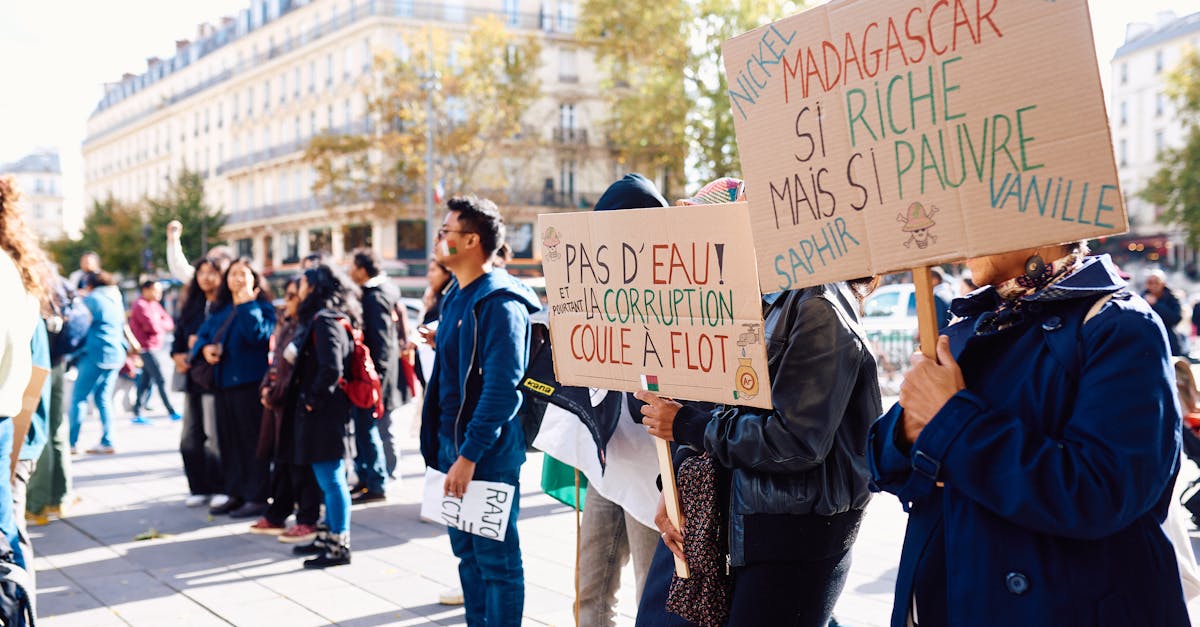

For the past few weeks, Madagascar has been the scene of a profound intergenerational conflict. Young people, embodied by Generation Z, have been vigorously protesting against the excesses of the current government, denouncing the plundering of natural resources and a political system perceived as opaque and corrupt. At the heart of this turmoil is Mamy Ravatomanga, an emblematic figure of Malagasy business, often considered a pillar of the country’s economic system, but also a prime target of criticism from the younger generation. Social media is ablaze, revealing a generational divide that challenges traditional relationships between economic power and engaged youth, and raises the crucial question of the role of these entrepreneurs in the social crisis. Ravatomanga’s reaction, during a notable television appearance, underscores the complexity of a conflict where financial, political, and moral issues are intertwined. His carefully calibrated speech attempts to defuse youth anger while affirming his loyalty to President Rajoelina amidst a storm of accusations and counterattacks. This multidimensional crisis reveals not only the fragility of political stability but also the impact that broadening the national debate can have, where each actor tries to protect themselves while shaping the country’s economic future.

Public reactions in Madagascar to the businessman’s influence in a context of social crisis.
Reactions to Mamy Ravatomanga are multiplying, oscillating between admiration for his economic role and denunciation of his involvement in practices deemed largely contrary to the public interest. Malagasy youth, particularly Generation Z, mobilized on social media, are expressing deep distrust, accusing him of being the architect of a rigid system that fuels impoverishment and prevents any genuine democratic evolution. Tensions are rising in the face of this divergence of opinions, illustrating how the figure of the businessman has become a symbol in Madagascar: a symbol of power, wealth, but also, according to his detractors, of economic predation. Beyond the rhetoric, this crisis, which calls into question the role of an economic elite in the country’s governance, reveals a shift in collective perception, where the figure of the wealthy and influential becomes a focal point around which an entire nation expresses its views. Criticism is no longer confined to social media but extends to traditional media, demonstrating that dissent has become institutionalized, making any form of unambiguous communication impossible in a climate marked by mistrust and a desire for change.
https://www.youtube.com/watch?v=8Nv9vMQf9sw Mamy Ravatomanga’s speech: strategies and messages in the face of criticism crafted by Generation Z
During his interview, Mamy Ravatomanga employed a strategic communication approach, driven by a desire to reassure the public while minimizing his responsibility in the crisis. His tone was firm; he denied any involvement in looting or illicit activities, insisting that his companies operate solely in private security and ruling out any participation in the violence that has gripped the capital since September 25th. For him, mastering public discourse and media relations are essential tools to mitigate the impact of criticism. His message also emphasized his ties to the government, positioning him as a key player, guaranteeing stability and economic development. Furthermore, Ravatomanga stressed the need to separate the businessman from politics, while emphasizing that he has no personal political ambitions. Thus, his intervention aimed to deter any rise in public distrust while consolidating his legitimacy in the face of controversy. Mastering communication during this crisis reveals the strategic importance of managing image to defend an economic legacy against a youth determined to denounce its shortcomings.

The challenges of entrepreneurship in a context of social and political crisis in Madagascar.
The situation in Madagascar highlights the complex position of businesspeople facing a demanding youth, who see entrepreneurship as a lever for change or, conversely, as a tool for maintaining the status quo. The crisis underscores that the private sector can play a crucial role in the stability or destabilization of the country. Ravatomanga’s strategies illustrate how entrepreneurship can become an instrument of power, capable of uniting or dividing society. The crisis also reveals the need for businesses to engage in genuine dialogue with civil society in order to redefine their role in the reconstruction of a rapidly changing country. Furthermore, every economic actor faces a dilemma: support political stability to continue prospering, or participate in protests to meet the expectations of young people and their desire for justice. This raises questions about the social responsibility of large corporations in the socio-political context, as well as the role they can play in supporting national reconciliation. The Malagasy crisis could therefore serve as a catalyst for a more ethical and socially integrated entrepreneurial model.
| Criteria | Description | |
|---|---|---|
| Impact on Madagascar | 🛡️ Security | Strengthening measures to protect economic and social sites. |
| Relative stability in a context of persistent violence. | 💼 Entrepreneurship | |
| Mobilization of private actors to support the national economy. | A possibility for sustainable economic reconstruction. | |
| 🤝 Dialogue | Entrepreneurs’ engagement in dialogue with youth. | |
| Promoting a peaceful and democratic transition. | 🌍 Communication |

Strengthening or weakening legitimacy depending on the consistency of the messages.
Counter-arguments to serious accusations.
Maintaining stability or precipitating the crisis.
Reactions of an influential businessman to Generation Z criticism in Madagascar: analysis of viewpoints and social issues.
The generational conflict: issues, causes, and perspectives.
The intergenerational conflict in Madagascar illustrates the profound rift between traditional economic authorities, embodied by figures like Ravatomanga, and a youth determined to make its voice heard. Generation Z, often perceived as more connected and more engaged, sees the practices of certain entrepreneurs as a symbol of injustice and inequality. The perception that these businesspeople use their influence to protect personal interests fuels a crisis of confidence that threatens the country’s stability. However, this confrontation could also pave the way for a reshaping of relations between different social and economic classes. Young people are demanding total transparency, an equitable distribution of wealth, and more democratic governance. The answer to this conflict could lie in a sincere dialogue, involving economic actors and civil society, to build together a more inclusive and equitable model. Otherwise, the crisis could spread, exacerbating divisions and halting all national progress.
https://www.youtube.com/watch?v=KPiFuPvUvNA Trends to follow for effective communication in a crisis context in Madagascar
In this Malagasy crisis, communication has emerged as a major strategic tool for containing protests or, conversely, amplifying them. Image control is essential for economic actors like Ravatomanga, who seek to preserve their reputation while avoiding becoming scapegoats. Transparency, coupled with authentic communication, could appease the anger of young people while strengthening their legitimacy. Well-calibrated communication, utilizing both traditional media and social networks, becomes a lever for pacification or further polarization, depending on the consistency of the messages disseminated. The key lies in the ability to listen to and respond to the expectations of young people while defending their interests. The communication strategy must also anticipate the possible course of the crisis in order to avoid an escalation that could permanently undermine national stability. This approach must prioritize genuine civic engagement, enabling constructive dialogue about a shared future.
How did Madagascar arrive at this social and political crisis of 2026? The crisis stems from a long chain of social demands, abuses of power, opaque resource management, and widespread youth discontent with a system perceived as corrupt and unjust.
What role does businessman Mamy Ravatomanga play in this crisis?
He symbolizes both economic stability and popular anger. His influence and strategic communication make him a key player, whose actions and statements either fuel or defuse tensions.
How does Generation Z influence the political and economic dynamics in Madagascar?
Through their demands, their use of social media, and their desire for transparency, these young people are disrupting the status quo, calling for renewed governance and a more equitable redistribution of wealth.
Découvrez notre guide complet — destinations, budget, visa, faune et conseils pratiques pour préparer votre voyage.

📖 Vous aimerez aussi

Transition à Madagascar : la société civile et la Génération Z face aux doutes sur le « Programme de la Refondation »
3 March 2026
Fermeture de l’aéroport de Dubaï : chaos et désarroi chez les voyageurs bloqués
2 March 2026