
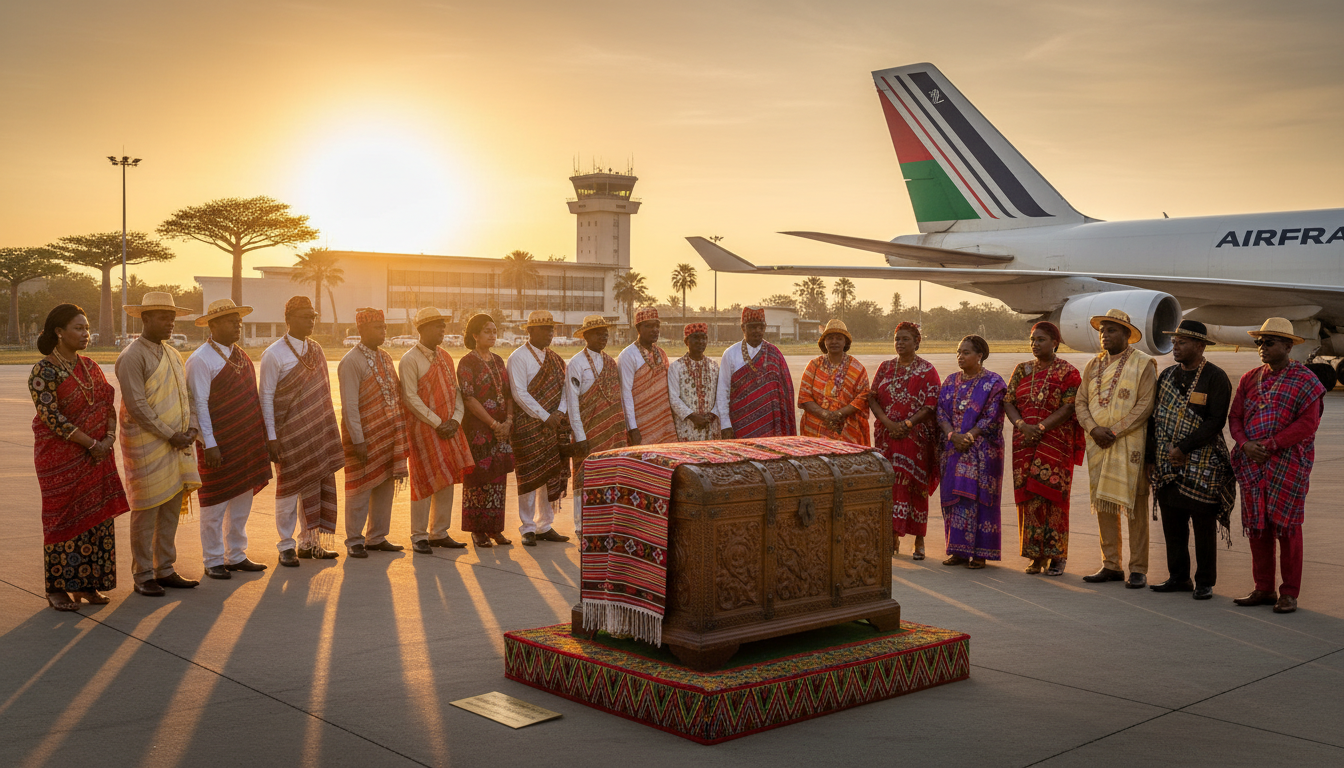

August 26th marked a memorable date in the annals of Franco-Malagasy relations, a moment when history and memory intertwined for a long-awaited return. After decades of waiting and negotiations, the skull of the Sakalava king Toera, accompanied by those of two warriors, finally returned to the land of its ancestors from France. This gesture, rich in symbolism, transcends a simple restitution of objects to become a true bridge between the painful colonial past and a future imbued with reconciliation. This heritage, once a war trophy, now regains its dignity and its place at the heart of ancestral Malagasy rituals, notably the “Fitampoha.” The event stirred waves of emotion in Madagascar, where the Sakalava community, as well as the entire nation, sees in this return a historical redress and a sign of renewed respect for their culture and traditions. This is a crucial step in acknowledging past injustices and building a more equitable relationship, illustrating the strength of the invisible bonds that unite a people to their history and their fallen heroes. In short: 📅 August 26:
Historic date of the
- restitution of the Sakalava skulls by France to Madagascar . 👑 Theskull of King Toera
- , the last independent ruler of Menabe, is at the heart of this symbolic return. ⚔️ Two other Sakalava warrior skulls were also returned, highlighting the scale of this initiative.
- ⚖️ A new French framework law passed at the end of 2023 facilitated this removal from public collections, marking a significant legal advancement.
- 🗓️ The choice of August for the return respects Sakalava customs and traditions, in connection with the Fitampoha ritual.
- 🕌 A “zomba”, sacred mausoleum, is planned in Ambiky to properly house these royal relics. 🤝 This gesture represents a major step towards reconciliation in memory and culture between France and Madagascar.
- 💔 The Malagasy Minister of Culture emphasized that the absence of these skulls had been an “open wound” for 128 years.
An Awaited Return: The Story of King Toera’s Skull and Sakalava Memory
August 26, 2025, will remain etched in the collective memory of Madagascar as the day of a poignant return: that of the skull of the Sakalava king Toera and two warriors, after more than a century in France. It is a story that dates back to the dark days of the colonial conquest, a tale of resistance, sacrifice, and ultimately, restored dignity. King Toera, an emblematic figure of Malagasy resistance, was tragically killed in 1897 during the deadly attack by French colonial troops on Ambiky, the former royal capital of the Menabe kingdom. His decapitation and the transport of his skull as a war trophy left a deep wound in the hearts of his people and descendants. For years, this precious heritage was kept at the National Museum of Natural History in Paris, among hundreds of other Malagasy human remains, far from his homeland and the rituals that should have accompanied it. The absence of these relics was perceived not only as physical dispossession, but also as an impediment to the spiritual and cultural wholeness of the Sakalava community. It was seen as an open wound, an invisible but indelible link broken between the present and the past. The demand for restitution The return of the Sakalava to Antananarivo is not a recent phenomenon; it is part of a broader movement to reclaim ill-gotten gains and acknowledge colonial injustices, a movement that has been gaining momentum across the African continent for several years. It is not simply an object that is being returned, but a part of a nation’s soul that is reclaiming its rightful place. The process has been long, marked by discussions and diplomatic negotiations, but the perseverance of the Malagasy authorities and the support of the Sakalava princely family have finally borne fruit, culminating in this historic day. This return symbolizes a strong commitment to redressing past wrongs and strengthening ties between peoples. The Battle of Ambiky and the Fate of the Ampanjaka The story of King Toera is that of a hero who fought fiercely to defend the sovereignty of his kingdom against the French colonial advance. The Battle of Ambiky, which took place at the end of the 19th century, was a bloody and decisive episode. The French troops, more numerous and better armed, faced the fierce resistance of the Sakalava, led by their sovereign, the
Ampanjaka Toera
It was an unequal confrontation, ending in the king’s death and the defeat of his troops. Oral accounts and the few available historical documents attest to the brutality of the era and the colonizers’ determination to crush all forms of opposition. The decapitation of King Toera, followed by the removal of his skull as proof of victory and submission, was an act of dehumanization and desecration in the eyes of the Sakalava people. Imagine the emotional and spiritual impact of such a loss on a community that venerates its ancestors and for whom royal relics are sacred. This act not only deprived the Sakalava of their leader but also of the opportunity to perform proper funeral rites, leaving a fragmented collective memory. King Toera’s skull has become a powerful symbol of Malagasy suffering under colonial rule, a constant reminder of the tumultuous history that shaped the nation. The Sakalava community has never forgotten its king, nor the need to pay him the honors he is due. The movement for therestitutionwas driven by this unwavering desire to restore the king’s dignity and allow his descendants to find peace. This shows us that even after more than a century, the quest for historical justice remains a powerful driving force. It is a journey that ends, but also a new chapter that opens for the heritage of Madagascar. It is a story that deserves to be told, again and again, so that we never forget the courage of those who defended their land. The Long Road to Restitution: Issues and Negotiations between France and Madagascar The
restitution
of the skull of King Toera to Madagascar This is not merely an event; it is the culmination of a complex political and memorial process that has lasted for years, involving high-level discussions between France and Madagascar. It is not a simple transaction, but the result of in-depth dialogue on issues of heritage, colonialism, and reconciliation. The Malagasy authorities insisted on this return, seeing in these skulls far more than objects of scientific study. For them, these relics represent a living link to the history and identity of the Sakalava people. On the French side, the question of the restitution of colonial property has become a major topic of debate in recent years, with a growing awareness of the need to confront the past. French President Emmanuel Macron, during a visit to Madagascar in April, clearly expressed his desire for this restitution to take place, referring to the creation of the “conditions” for “forgiveness” in the face of the “bloody and tragic pages” of colonization. This kind of statement demonstrates a significant shift in approach, seeking to ease historical tensions and build new foundations for cooperation. This dialogue was crucial in overcoming the legal and administrative obstacles surrounding the removal of these human remains from French public collections. There was a clear political will on both sides to move this matter forward, recognizing the symbolic importance of this gesture for both nations. Reconciling the scientific imperatives of conservation with memorial and cultural demands is not always easy, but in this particular case, a balance was struck. To learn more about the challenges of historical justice, one can explore other aspects of the recovery of ill-gotten gains. These are complex but essential questions for post-colonial countries. It’s a long-term undertaking, but every step counts. A framework law to facilitate the return of human remainsThe
restitution
of Sakalava skulls to Madagascar has benefited from a major legal advancement in France. Indeed, it marks the first application of a framework law passed at the end of 2023. This innovative legislation aims to facilitate the return of human remains from public collections without requiring specific legislation for each case. Previously, each request for the restitution of objects or human remains held in French museums required specific legislation, a cumbersome and time-consuming process. With this new law, the process is simplified, allowing for greater fluidity in heritage procedures. and reconciliation. We can only applaud this initiative, which recognizes the specific nature of human remains and their cultural and memorial importance, often distinct from that of works of art. The French Minister of Culture, Rachida Dati, emphasized that these skulls entered national collections under conditions “that objectively violate human dignity and within a context of colonial violence.” This official recognition of past circumstances is fundamental to the healing process and the rebuilding of relationships. It is observed that this law paves the way for other potential restitutions, not only for Madagascar, but also for other countries whose human heritage was collected in similar contexts. This is a strong ethical and political step, which repositions France in its relationship with its colonial past and with partner nations. This is excellent news for the future of cultural relations and a decisive step towards historical justice. If you wish to delve deeper into this subject, you can read about the discussions surrounding the restitution of Malagasy skulls, which are crucial for understanding the current context. This is a symbolic, but also very concrete, step for the communities involved. It’s a striking example of how the law can serve memory and culture. `; rootContainer.innerHTML = timelineHTML;
/ Content for mobile (always to the right of the vertical line)
const mobileContent = document.createElement(‘div’);
const desktopContentWrapper = document.createElement(‘div’);
// ‘hidden md:flex’: hidden on mobile, visible and uses flexbox on desktop
leftContent.innerHTML = `
}); }// Execute the function to generate the timeline as soon as the script is loaded
generateTimeline();
/* Constraint: 100% Free APIs/Services
Comment: For this interactive timeline, all data (title and events) is provideddirectly in the JavaScript script as a `timelineData` object. Therefore, no external API is used or required for this tool to function. If the tool had needed dynamic external data, I would have selected a free public API without an API key (or with a key provided freely and without major restrictions). Example of a free public API (not used here, just for illustration): – API name: Wikipedia API (for general information searches) – Base URL: `https://fr.wikipedia.org/w/api.php`
– Example call to search for information on “Madagascar”:
`https://fr.wikipedia.org/w/api.php?action=query&prop=extracts&exintro&titles=Madagascar&format=json&origin=*` – Example of a simplified JSON response: `{“batchcomplete”: true, “query”: {“pages”: {“10271”: {“pageid”: 10271, “ns”: 0, “title”: “Madagascar”, “extract”: ” Madagascar, officially theRepublic of Madagascar…”}}}}}` */https://www.youtube.com/watch?v=tQbd7UprN3A August 2026: The Rhythm of the Ancestors and the Fitampoha The choice of August for the return of the skull of King Toera and the two Sakalava warriors to Madagascar is not insignificant; it is deeply rooted in the traditions and customs of the Sakalava community. This decision, the result of an agreement between the President of the Republic and representatives of the princely family, aims to ensure that the return takes place “in accordance with Sakalava customs and traditions.” August is traditionally associated with the “Fitampoha,” or bathing of the royal relics, an ancestral ceremony of paramount importance to the Sakalava people of Menabe. This period is sacred, conducive to rituals of ancestor veneration. The Fitampoha, which formerly consisted of cleaning the bones of deceased kings and covering them with aromatic oil and honey, is much more than a simple tradition; It is an act of spiritual connection, a way to ask for the blessing of the royal ancestors and to maintain the balance of the community. Historically, this rite was performed annually in the 17th century, under the impetus of King Andriandahifotsy, before becoming decennial in 1904, and then quinquennial since 1988. Although the next major Fitampoha celebration took place in 2021, the month of August remains a symbolically powerful window for the gathering of royal relics and the creation of the holy “relic,” as it is called, for future rituals. It is a gesture that shows how much theculture Malagasy culture, and particularly that of the Sakalava people, is vibrant and respected in this process. It is clear that the government did not want to rush things, despite the French decree of April 3rd, which stipulated a one-year deadline for the repatriation of human remains to the Musée de l’Homme (Museum of Man). The president’s desire to see this return take place “in a context of serenity and unity for all Malagasy people” prevailed, emphasizing the importance of popular support and respect for local traditions. This is a lesson in humility and wisdom, prioritizing the long-term perspective of memory and ancestral rituals over administrative urgency. This return therefore marks a turning point, but one rooted in respect for age-old traditions. Preparations and Traditional Rituals To properly receive theskull of King Toera and those of his warriors, considerable preparations are underway inMadagascar
, particularly in the Menabe region. The idea is to organize a ceremony “worthy of and befitting the historical and symbolic significance of the return of Ampanjaka Toera’s skull.” The Ministry of Communication and Culture, in consultation with the royal descendants, is working tirelessly to ensure everything is perfect. Plans include the construction of a “zomba” in Ambiky, the former capital of the Sakalava Kingdom of Menabe, located in the Belo sur Tsiribihina district. A zomba is a sacred mausoleum, a place of eternal rest and veneration for Sakalava kings. It is there that Ampanjaka’s body will be symbolically “united,” allowing his descendants to assemble his relics for future Fitampoha rituals.
The construction of this zomba is not merely an architectural project; it is an act of memorial reconstruction, a way of giving back to Caesar what belongs to Caesar, or rather, to the ancestors what is rightfully theirs. It means recreating a space where the king can be honored according to sacred rites, guaranteeing the continuity of cultural and spiritual practices. One can imagine the excitement and emotion within the Sakalava community as this event approaches. The restitution is an opportunity to strengthen ties, to transmit history and traditions to younger generations, and to reaffirm the cultural identity of the ethnic group. Ceremonies are also planned in Antananarivo with all the Ampanjaka before the transfer of the skulls to Menabe, emphasizing national unity around this event. This is an approach that goes far beyond politics, touching on the very essence of what it means to be Malagasy. To gain a deeper understanding of local issues, one can learn about land conflicts in regions like Sakatia, which demonstrate the importance of land and territory to communities. These are complex subjects, but they illuminate the richness of the Malagasy context. We see that every detail counts in honoring the memory of the Sakalava king. This is a tribute paid not only to a man, but to an entire culture. Beyond the Skulls: The Symbolic Significance for Malagasy Heritage The return of the Sakalava skulls to Madagascar goes far beyond the simple act of returning human remains; it is an event of immense symbolic significance for heritage. cultural and Malagasy national identity. It is a moment of historical reparation, recognition, and pride. As the Malagasy Minister of Culture, Volamiranty Donna Mara, so aptly put it, these skulls are not “simply collector’s items.” They embody “the invisible and indelible link that unites our present with our past.” For over a century, 128 years to be exact, their absence was perceived as “an open wound in the heart of our island.” This return allows us to heal this wound, to mend a part of our history, and to restore the dignity of a people. It is clear that this gesture is essential for national unity, reminding all Malagasy people of their collective strength and their capacity to overcome adversity. The Sakalava culture, with its ancestral rites and beliefs, is highlighted and celebrated through this event. This is an affirmation of the richness and diversity of Madagascar’s heritage, which is not limited to material possessions but also includes stories, memories, and royal lineages. This gesture by France is also seen as a strong signal to other nations holding colonial assets, encouraging them to follow this example. It is a victory for cultural diplomacy and international cooperation. This is more than just the story of King Toera; it is the story of an entire country reclaiming its past to better build its future. This return is a source of inspiration for future generations, showing them the importance of their heritage and the value of their identity. To learn more about other aspects of Malagasy sovereignty, one can explore the debate on the Scattered Islands at the UN. These are territorial issues equally laden with symbolism and history. Every step towards the recognition of sovereignty and heritage adds another stone to the edifice of the Malagasy nation. It breathes new life into collective memory. It is also a powerful message of resilience for the entire world. An indelible link between past and present The return of the skull of the Sakalava king reinforces the indelible link that unites the past and present of Madagascar, particularly for the Sakalava people. A people cannot be separated from its history, its ancestors, and its symbols. The physical presence of these relics, although their authenticity for King Toera is “presumed” according to scientists, is of paramount importance. It offers a tangible anchor for collective memory and ritual practices. As the Malagasy minister aptly stated, this absence was a wound, and its healing depends on this return. For the Sakalava, this means that their ancestors are no longer distant trophies, but guardians of their heritage, finally resting on their sacred land. This event paves the way for a better transmission of history and culture to younger generations. One can imagine the stories that will be shared around the “zomba” being built in Ambiky, the songs and dances that will accompany the ceremonies. These moments of sharing are essential for forging cultural identity and a sense of belonging. Moreover, this restitution
This is a concrete example of the reaffirmation of Madagascar’s cultural sovereignty. It demonstrates that the nation is capable of defending its historical interests and engaging in dialogue with former colonial powers on an equal footing. It sends a powerful message to the rest of the world: Malagasy heritage is not for sale or to be exhibited without its consent. This initiative is part of a global movement toward the decolonization of museums and the recognition of the rights of indigenous peoples to their cultural property. There is an immense sense of pride, a renewed energy emanating from this event. It is a unique opportunity to reconnect with one’s roots and to look to the future with hope. To understand how these dynamics affect governance,
it is helpful to examine efforts to end impunity and build a better justice system for all. This is a movement toward transparency and respect. It is a page turning, a new chapter beginning, and we are here to follow it closely! https://www.youtube.com/watch?v=8horAfUR2MIThe Challenges and Future of Restitutions: A New Era of CooperationThe restitution of the skull of the Sakalava king undeniably marks a major milestone, but it also opens a new era, full of challenges and promises for future cooperation between France and Madagascar and beyond. This is not an end point, but rather a new beginning. The French framework law, applied for the first time with these skulls, now facilitates the removal of artifacts from public collections, which could encourage many other requests. We must anticipate the implications of this new legal flexibility: what will be the next items claimed? How will the authentication and dialogue processes be managed? Minister Rachida Dati clarified that the work of scientists had made it possible to establish “with certainty” the provenance of the skulls from the Sakalava community, but that the attribution to King Toera remained a “presumption.” This distinction is important for both parties, as it underscores scientific rigor while respecting the historical significance of the artifacts. Scientific cooperation surrounding these restitutions is essential to guarantee the traceability and respect of the objects. We see that these gestures of goodwill strengthen the diplomatic and cultural ties between the two countries, paving the way for more balanced and respectful partnerships. Imagine the joint research projects, traveling exhibitions, or expert exchanges that could emerge from this new dynamic. It’s an opportunity to build together a new narrative of history, far removed from colonial clichés. However, challenges remain, particularly regarding the management and conservation of this heritage once repatriated. Madagascar will need to develop its museum infrastructure and conservation capacities to properly house these treasures. To this end, agreements such as the one between Madagascar and Switzerland on cultural assets are crucial, as they can provide the resources necessary for cultural development. This is work that requires time, resources, and sustained commitment. We are convinced that this restitution is a catalyst for richer and more fruitful cooperation, not only in the field of heritage, but also in other sectors. It is a true example of a “win-win” situation, where
and
Madagascar are moving forward together towards a shared future. It is a beautiful story of international relations unfolding before our eyes. It is a source of hope for future collaborations. 🌍 Building a “zomba” and honoring memory One of the most moving aspects of this restitution is the upcoming construction of a “zomba” in Ambiky, the former capital of the Sakalava kingdom. We are talking about more than just a simple building; This is a sacred place, a royal mausoleum, intended to house theskull of King Toeraand those of his warriors. This project symbolizes the reappropriation and revitalization of Sakalava culture. The construction of the zomba is a community undertaking, a gathering around the memory of the ancestors. It will allow for the “unification of the body of the Ampanjaka,” that is, the symbolic restoration of the integrity of the royal figure, and the creation of his relics for the Fitampoha ritualsheld in August. This is not just a place of rest; it is a center of cultural and spiritual life, where traditions will be passed on and celebrated. We can imagine the descendants of King Toera actively involved in this project, ensuring that every detail respects ancestral customs. This initiative demonstrates that restitution does not end with the return of the objects; it extends to how these objects are reintegrated into the life of the community. The importance of giving concrete meaning to these returns is evident. It is not about storing the skulls in a museum, but about placing them back at the heart of local ritual practices and beliefs. This requires close coordination between national authorities, local communities, and traditional representatives. National debates and consultations, such as those found on this page dedicated to citizen reflections , are essential to ensure that such initiatives reflect everyone’s aspirations. It is an inclusive approach that strengthens the sense of belonging and collective pride. This is a beautiful project that unites the past and the future, tradition and modernity. We believe that this is precisely the kind of initiative that gives true meaning to the restitution of heritage . It is a work for future generations. 🏛️ Here are some key points to remember: 🤝 The restitution
is the result of collaboration and ongoing dialogue between the French and Malagasy governments.
📜 A new framework law in France now facilitates the removal of human remains from public collections. ✨ The return of the skulls is a powerful symbol of reconciliation and recognition of history . 🗓️ The timing inAugust was chosen to align with Sakalava traditions, particularly theFitampoha . 🕌 The construction of a “zomba” in Ambiky underscores the importance of reintegrating this heritage into ritual practices. 🇲🇬 For
Madagascar
- This is a crucial step in building its identity and healing the wounds of colonialism.
- 🌐 This gesture is an example for other countries facing similar demands for the restitution of colonial artifacts. Key Step
- Event Description Actors Involved Symbolic Impact 🌟Resistance of King ToeraDeath of
- King Toera during the Battle of Ambiky in 1897, the beginning of French colonization. King Toera, French colonial troops Symbol of Malagasy resistance to oppression.Preservation in France
- The skulls were taken as trophies and kept at the National Museum of Natural History in Paris for over a century.
- National Museum of Natural History, French public collectionsOpen wound for the Sakalava community and Madagascar.
| Requests for Restitution | Multiple requests from | Madagascar | for the return of its |
|---|---|---|---|
| cultural heritage. | Malagasy authorities, descendants of the Sakalava king Long quest for historical justice. | New French Framework Law | Law passed at the end of 2023 facilitating the removal of human remains from public collections. |
| French Government, Parliament | Major legal advancement for restitution. Postponement Agreement (April 2025) Decision to postpone the | restitution ceremony | initially scheduled for April to |
| August | , to respect Sakalava customs and traditions. President of the Malagasy Republic, Sakalava princely family Respect for traditions and national unity. Restitution Ceremony (August 26, 2025) Official handover of the three | skulls | (including that of |
| King Toera | ) to the French Ministry of Culture. French Minister of Culture, Malagasy Minister of Culture | Historic event and gesture of reconciliation. | Return to Madagascar (August 31, 2025) |
| Arrival of the skulls on Malagasy soil for burial. | Malagasy authorities, Sakalava community Return to their roots, beginning of healing. Construction of the Zomba Project to build a sacred mausoleum in Ambiky to properly house the relics.Sakalava community, Malagasy authorities | Reintegration of heritage into culture and rituals. | Why is King Toera’s skull so important to Madagascar? |
| King Toera’s skull is much more than a historical relic; it is a powerful symbol of Malagasy resistance against French colonization. For the Sakalava people, it represents the soul of their sovereign and ancestors, whose physical presence is essential for traditional rituals like the Fitampoha. Its absence was perceived as an “open wound,” and its return is an act of memorial reparation and national pride. | What is the Fitampoha and why is it linked to restitution? The Fitampoha is an ancestral ceremony practiced by the Sakalava people of the Menabe region in Madagascar. This is the bathing of royal relics, a ritual of ancestor veneration during which the bones of deceased kings are cleansed. The month of August is traditionally associated with this sacred period. The postponement of the restitution to August 2025 was decided by mutual agreement to respect these customs and traditions, allowing the return of the skulls to be integrated into a culturally significant context. How was France able to return the skulls after so long?The restitution was made possible thanks to a new framework law passed in France at the end of 2023. This legislation facilitates the removal of human remains from public collections without requiring specific legislation for each case, as was previously the case. This more flexible legal framework, combined with France’s political will to confront its colonial past, enabled this historic event, acknowledging that the skulls had entered the collections under conditions contrary to human dignity. | What is the impact of this restitution on Franco-Malagasy relations? | The return of King Toera’s skull marks an important step in the reconciliation of historical memory between France and Madagascar. It is seen as a gesture of goodwill and recognition of the tragic chapters of colonization. This paves the way for new forms of cultural and scientific cooperation, strengthening diplomatic ties and laying the foundations for more equitable partnerships. It is a step towards healing the wounds of the past and building a shared future. |