
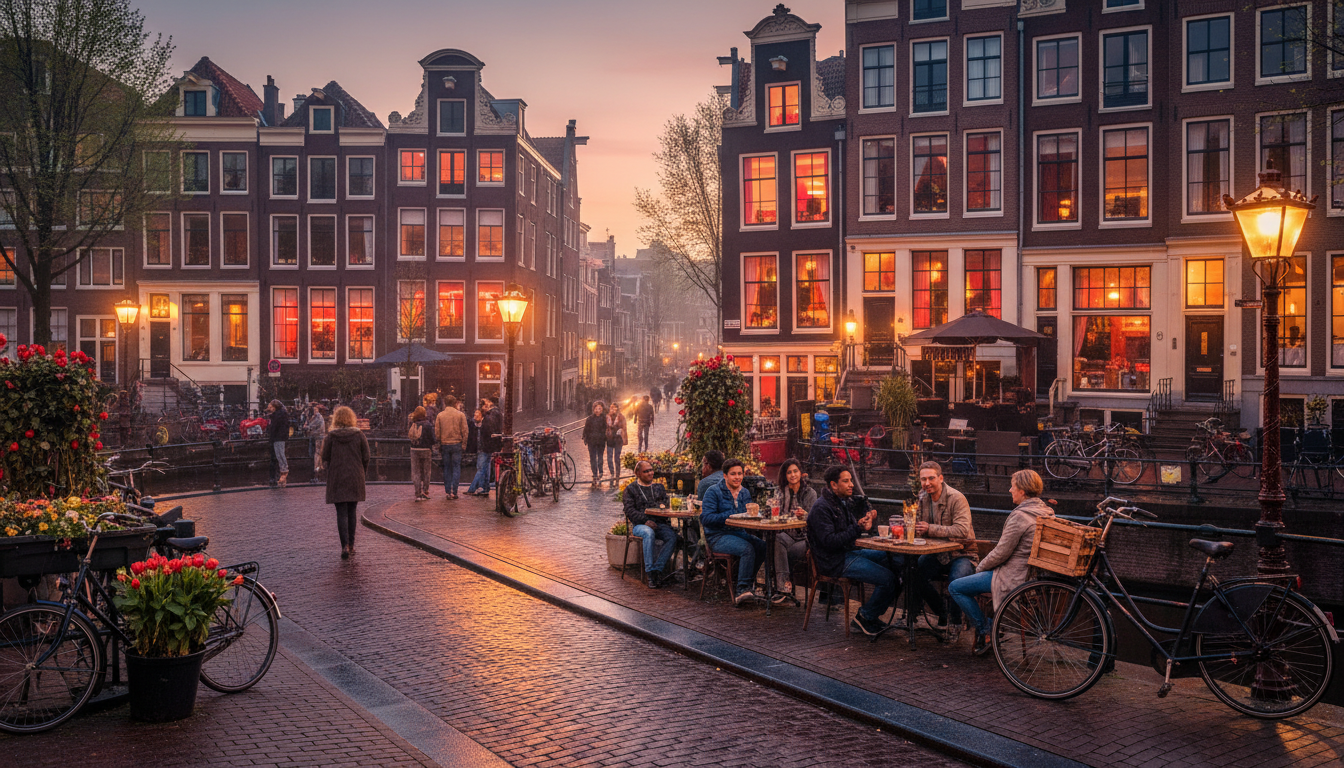

Amsterdam’s famous De Wallen district, better known as the Red Light District, invites a rich and nuanced exploration that goes far beyond its infamous reputation. Far from being just a place for nighttime curiosity, it’s a true historical melting pot where picturesque canals meet splendidly preserved medieval architecture, offering visitors a glimpse into centuries of urban storytelling. This iconic district, which originated in the 14th century, embodies the Dutch tolerance and open-mindedness that are so characteristic of the capital. For explorers eager to venture into its cobbled streets, a thorough understanding of its history, customs, and rules is essential to ensure a safe and deeply rewarding visit. Let yourself be guided through its secrets, surprising museums, and breathtaking viewpoints for a truly memorable experience in the heart of Amsterdam.
- In short: your express guide to a successful visit to Amsterdam’s Red Light District 💡 Fascinating History
- : De Wallen is Amsterdam’s oldest district, boasting over 700 years of history and unique medieval architecture. 🏛️
- Cultural Treasures : Don’t miss the Oude Kerk (Old Church), the Museum Ons’ Lieve Heer op Solder (Our Lady of Solder Museum), and Red Light Secrets for a complete immersion.
- 📸 Clear Rules : Photographing the windows is strictly prohibited to respect the privacy of the sex workers. Violation results in hefty fines.
- 👮♀️ Enhanced Security
- : The district is generally safe thanks to a 24/7 police presence and surveillance cameras, but be vigilant against pickpockets and scams. 🗓️
- Best time to visit: A daytime visit offers a peaceful and cultural atmosphere, while the evening (7-9 pm on weekdays) reveals the neighborhood’s iconic character, with its red lights. 🍽️
- Local cuisine Discover typical restaurants and cafes for an authentic gourmet break between explorations.
🚶♀️
Accessibility: Easily accessible on foot from Central Station or Dam Square, as well as by metro or tram.
💰 Reasonable Budget : Exploring the streets is free, but budget for museums and meals (approximately €40-80 per person for a full day).
Dive into the History and Unique Architecture of De Wallen: Over Seven Centuries of Urban Tales in AmsterdamExploring the De Wallen district is like embarking on a fascinating journey through time, right in the heart of Amsterdam.
It’s not just the Red Light District you’ll be exploring, but the birthplace of the Dutch capital, a place where every stone, every canal, every alleyway tells a story spanning over seven hundred years. Founded in the 14th century, De Wallen, named after the ancient city walls that once protected the city, is a time capsule that has preserved its medieval charm while adapting to the constant evolution of society. Here, one discovers incredibly well-preserved architecture, characterized by its tall, narrow canal houses, many of which are listed as historical monuments, that lean gracefully over the waters of the famous Oudezijds Voorburgwal and Oudezijds Achterburgwal canals. These waterways, far more than mere landscape features, have been the lifeblood of Amsterdam’s commerce and daily life for centuries, a testament to the Dutch ingenuity in mastering their environment. The history of this district is intrinsically linked to its strategic location. Close to the port, it quickly became a crossroads for sailors and merchants from all over the world, shaping a culture of tolerance and pragmatism. Prostitution has been legal and regulated here since 2000, reflecting a tradition of pragmatic management rather than outright repression—an approach that sets Amsterdam apart on the international stage. This regulation aims to ensure the safety of sex workers and to govern the activity, even if it remains a subject of ongoing debate. Strolling through the winding streets, one perceives this duality: an incredibly rich historical heritage blending with contemporary activity that continues to attract millions of visitors each year. It is fascinating to observe how these two realities coexist, creating an atmosphere that is both peaceful by day and vibrant by night. Beyond the brightly lit shop windows, which are undoubtedly De Wallen’s most famous feature, lie true architectural and cultural gems. TheOude Kerk The Old Church, or De Wallen, is undoubtedly one of the highlights of any visit. Built in 1306, it is quite simply the oldest church in Amsterdam, a masterpiece of Gothic architecture that dominates the neighborhood with quiet majesty. Its vaults soar towards the sky, its stained-glass windows tell ancient stories, and its 15th-century wooden floor whispers the footsteps of generations of worshippers and visitors. You can admire sculpted details, feel history beneath your feet, and even, for the more adventurous, climb the bell tower (for an additional fee of around €8) to enjoy a breathtaking panoramic view of Amsterdam’s rooftops and the labyrinthine streets of the district. It’s a vantage point that offers a unique perspective on the complexity and beauty of De Wallen, allowing you to grasp the full extent of this maze of alleyways and canals. Did you know that Rembrandt himself married Saskia in this church in 1634? This anecdote further cements this place in the history of art and the city.
Another hidden treasure, a testament to the religious tolerance so dear to the Netherlands, is the Museum Ons’ Lieve Heer op Solder, or “Our Lord in the Attic.” This incredible museum is actually a clandestine 17th-century Catholic church, cleverly concealed in the attic of three joined canal houses. At a time when the practice of Catholicism was forbidden in public, this secret church allowed the faithful to practice their faith discreetly. A visit here is a moving experience, a poignant testament to ingenuity and perseverance. Inside, you’ll discover a richly decorated altar, antique wooden pews, and an atmosphere imbued with spirituality, far removed from the outside world. This is a fascinating discovery that perfectly illustrates the spirit of freedom and tolerance that has always animatedAmsterdamThe entrance fee, around €16, is a small price to pay for this immersion into a little-known chapter of history.
Walking through the streets, one is constantly struck by the contrast between past and present. The building facades, with their characteristic gables, recall the golden age of Dutch commerce, while the modern boutiques and coffee shops bear witness to a vibrant urban life. It is this juxtaposition that makes De Wallen so unique and captivating. The canals, for their part, offer magnificent vistas, with their floating barges and elegant bridges. Every street corner reveals a new surprise, a new story. Exploring De Wallen means understanding that this district is much more than just a tourist attraction; it is a vibrant testament to the history, culture, and avant-garde spirit of Amsterdam, a place that continues to evolve while honoring its past. Discover the Beating Heart of the Red Light District: Must-See Attractions and Enigmatic Spaces to Explore Amsterdam’s Red Light District, or De Wallen, is a destination that leaves no one indifferent, a veritable whirlwind of experiences where past and present collide in striking ways. Beyond the historic facades and serene canals that can be admired, this district is brimming with attractions that deserve special attention. They offer a deeper perspective on the culture and history of this unique place, allowing for true urban exploration. While the Oude Kerk (Old Church) and the Museum Ons’ Lieve Heer op Solder (Our Lady of Solder Museum) are must-sees for their historical and religious significance, other sites complete this rich mosaic, each adding its own nuance to the complex picture of De Wallen. Among these iconic locations is the Red Light Secrets – Museum of Prostitution.This museum stands out as a crucial step for anyone wishing to understand the inner workings of the sex industry in Amsterdam. It offers a unique immersive experience, not to judge, but to inform and educate. Inside, the testimonies of anonymous sex workers shatter stereotypes and provide an authentic glimpse into their lives, motivations, and the challenges they face. One of the most striking exhibits is a recreated shop window, where visitors can sit and imagine what the workers experience, transforming them first into an observer, then into an integral part of the experience, if only for a moment. It’s a rare opportunity to see the world from the other side of the glass, to confront one’s own prejudices, and to gain a more nuanced understanding of this regulated profession. With an entrance fee of around €17 and extended opening hours (10am-10pm daily), this museum, which is not suitable for those under 16, is a thought-provoking and thought-provoking experience exploring themes of tolerance and work ethic in Amsterdam. Approached with respect and curiosity, it can be an extremely enriching experience. The exploration wouldn’t be complete without a stroll across the Blauwbrug Bridge. This neo-Baroque bridge majestically spans the Amstel River and offers magnificent views of the canals, including the impressive Stopera Opera House. It’s a perfect spot to capture the essence of Amsterdam in photos, with its canal boats, typical houses, and reflections in the water. Its elegant structure and ornamentation are reminiscent of Parisian bridges, adding a touch of grandeur to the urban environment. It’s a focal point where you can pause, breathe, and admire the city from a different perspective. The Blauwbrug is an ideal photo spot, especially at sunset when the city lights begin to twinkle, offering an unforgettable spectacle for photographers and lovers of beautiful views. It’s a reminder that the neighborhood is much more than its shop windows: it’s also an architectural marvel.
Continue your walk towards the Zeedijk, one of Amsterdam’s oldest and most fascinating streets. This former dike, which protected the city from flooding centuries ago, is now home to a vibrant part of Amsterdam’s Chinatown. Here, the aromas of exotic spices mingle with the sounds of lively conversations, and the colorful storefronts of authentic Asian restaurants invite you on a culinary journey. Hidden Buddhist temples, Asian supermarkets brimming with unique products, and a cosmopolitan atmosphere stand in stark contrast to the rest of De Wallen. The medieval architecture is also remarkably well-preserved, offering a glimpse into what Amsterdam was like hundreds of years ago. Strolling along Zeedijk reveals another facet of Amsterdam’s cultural diversity, a place where Asian traditions have seamlessly integrated into the Dutch urban fabric. It’s a guaranteed immersive and enriching experience. Finally, the Warmoesstraat Warmoesstraat is another historic thoroughfare that deserves special attention. Active as a shopping street since the Middle Ages, it has always been a place for meeting and exchanging ideas. Today, it’s dotted with quirky boutiques, discreet coffee shops, and lively bars that particularly come alive after dark. It’s an ideal place to feel the pulse of Amsterdam’s nightlife without being overwhelmed by the hustle and bustle of the shop windows. You can find original souvenirs, vintage clothing, or simply sit on a café terrace and watch the world go by. Warmoesstraat offers a different perspective on the neighborhood’s evolution, showing how a place can retain its historical essence while constantly reinventing itself. It’s an eclectic mix of culture, commerce, and entertainment that perfectly illustrates Amsterdam’s dynamism. Exploring these different areas reveals that the Red Light District is a multifaceted destination, offering much more than its initial reputation suggests—a true invitation to urban exploration. https://www.youtube.com/watch?v=SZNo_fnG_W8
Navigating De Wallen Safely: Understanding the Rules, Avoiding Pitfalls, and Enjoying Your Visit Responsibly Visiting De Wallen in Amsterdam is a unique experience, but it requires a respectful and informed approach to ensure a safe and enriching visit. This district, with its distinctive character and reputation, is governed by specific rules designed to protect everyone, from residents and sex workers to tourists. Ignoring these rules can not only spoil the experience but also lead to legal or unpleasant consequences. The key is awareness and mutual respect—fundamental principles for urban exploration.successful and harmonious. Before venturing into the alleyways, it is essential to know the guidelines for optimal travel safety.
The first and most important of these rules concerns photography and video. It is strictly forbidden to photograph or film shop windows, including the sex workers inside. This prohibition is not a mere recommendation; it is a strict rule enforced to protect the privacy and dignity of the people who work there. Failure to comply with this rule may result in the confiscation of your camera or phone and a hefty fine of up to €95. This is an essential measure of responsible tourism, which requires visitors to be discreet and respectful. On the other hand, it is perfectly acceptable to take photos of the architecture, canals, streets, and the general atmosphere of the neighborhood, as long as it does not directly target shop windows or individuals without their explicit consent. The idea is to enjoy the beauty of the place without encroaching on the personal space of others. Beyond taking photos, general behavior is also crucial. It is strongly discouraged to knock on windows, stare intently at the sex workers, or approach them inappropriately. Respecting their space and their work is paramount. It is also important to remain discreet, not to block passage in the narrow and often crowded streets, and to speak at a normal volume, without shouting, especially at night. These simple actions help maintain a pleasant and peaceful atmosphere for everyone. Similarly, the consumption of hard drugs is completely illegal in De Wallen, as everywhere else in the Netherlands. Selling alcohol on the street is also prohibited, and public urination is punishable by a fine of €140. These rules are in place to maintain public order and quality of life in this densely populated and highly visited area, reinforcing the concept of travel safety.
Ensuring a Safe Visit: Understanding the Risks and Adopting Best Practices in Amsterdam Despite its reputation, De Wallen is a surprisingly safe neighborhood, thanks to a strong police presence and a 24/7 surveillance camera network. The streets are well-lit, and the large number of tourists means you’re never truly alone, even in the early hours of the morning. However, as in any busy tourist area, some risks remain, and it’s wise to be prepared. Pickpockets are a reality, especially in dense crowds. It’s therefore recommended to keep your bag in front of you, use only your front pockets for valuables, and avoid taking out your phone unnecessarily. Caution is always advised. Common scams should also be watched out for. For example, ignore the “coffeeshop guides” who approach you on the street; they often try to steer you towards disreputable establishments or sell you poor-quality products. Be wary of fake dealers offering cut drugs or counterfeit substances. Strip clubs can also be traps, with unexpectedly high bills for unsolicited drinks. Finally, unofficial taxis can charge exorbitant fares, often three times the normal price; always opt for official taxis or reputable ride-hailing apps for your urban exploration. This advice applies to any tourist city, such as when deciding to travel to Marrakech in November; you should always remain vigilant regarding local practices. Regarding substance use, cannabis is only tolerated in licensed coffeeshops. Smoking is strictly prohibited in the street, parks, or any other public place, under penalty of a fine. If this is your first time, be extremely careful with the dosage, especially with edibles (space cakes), which can be very potent. Always start with a small amount and wait to feel the effects before consuming more. Excessive consumption can lead to a bad experience and alter your perception of reality, seriously compromising your travel safety. For a first visit, opt for the daytime, when the neighborhood is quieter and the atmosphere less festive. Avoid late weekend evenings, when crowds are denser and the atmosphere can become chaotic. If you visit at night, stay on well-lit main streets and, if possible, in a group. Never follow anyone into a dark alley, no matter what they offer. These simple precautions will guarantee a pleasant and worry-free experience, allowing you to enjoy the unique cultural heritage of De Wallen with complete peace of mind. Amsterdam: Your Safe Guide to De WallenNavigate the famous Red Light District with confidence and respect thanks to our essential tips for an enriching and hassle-free visit.
`; // Creates the container for the detailed tip content (hidden by default). const content = document.createElement(‘div’); content.id = `tip-content-${index}`; content.className = ‘accordion-content’; content.setAttribute(‘aria-hidden’, ‘true’); // Indicates that the content is hidden
content.innerHTML = ` ${tip.detail}`; / Adds the created elements to the main container of the infographic.
item.appendChild(button);
item.appendChild(content);
safetyTipsContainer.appendChild(item); / Adds an event listener to the button to handle the opening/closing of the accordion. button.addEventListener(‘click’, () => {
const isOpen = button.getAttribute(‘aria-expanded’) === ‘true’; // Single accordion behavior: closes all other open elements. document.querySelectorAll(‘.accordion-button.open’).forEach(openButton => { if (openButton !== button) { // Does not close the currently clicked element
openButton.classList.remove(‘open’); openButton.setAttribute(‘aria-expanded’, ‘false’); const openContent = document.getElementById(openButton.getAttribute(‘aria-controls’)); if (openContent) { openContent.classList.remove(‘open’);
openContent.setAttribute(‘aria-hidden’, ‘true’);
if (isOpen) {
// If already open, close it button.classList.remove(‘open’); button.setAttribute(‘aria-expanded’, ‘false’); content.classList.remove(‘open’); content.setAttribute(‘aria-hidden’, ‘true’); } else { // If closed, open it button.classList.add(‘open’); button.setAttribute(‘aria-expanded’, ‘true’); content.classList.add(‘open’); content.setAttribute(‘aria-hidden’, ‘false’); } }); }); // — End of JavaScript script — Rhythms and Flavors of De Wallen: When to Visit, Where to Eat, and Culinary Delights in the Heart of Amsterdam Choosing the right time to explore De Wallen in Amsterdam and knowing where to take a gourmet break is essential for a rewarding visit. The neighborhood offers very different faces depending on the time of day, each with its own charm and atmosphere. Understanding these nuances allows you to best plan your urban exploration, whether you’re looking for a peaceful stroll, a cultural immersion, or a vibrant nightlife experience. Gastronomy, meanwhile, adds another layer to the discovery, offering a welcome break and the opportunity to savor the local and international flavors that make up the rich tapestry of Amsterdam attractions. In the morning Between 8 a.m. and noon, De Wallen reveals itself in a surprisingly peaceful light. This is the ideal time for those who wish to admire the medieval architecture, serene canals, and historic monuments without the crowds. The shop windows are generally closed, meaning there isn’t yet a palpable “Red Light” atmosphere, making the area conducive to families and contemplative strolls. It’s the perfect window for taking photos of the canals bathed in the morning light, visiting the Oude Kerk (Old Church) or the Museum Ons’ Lieve Heer op Solder (Our Lord the Soldier Museum) in tranquility. Many cafes and restaurants open their doors, offering delicious breakfasts and coffees to start the day off right. It’s a time for reflection, when one can truly appreciate the neighborhood’s cultural heritage in all its quiet splendor. In the afternoon, from noon to 6 p.m., the neighborhood gradually begins to come alive. Shop windows are gradually opening, and there are more tourists, but the crowds generally remain manageable. Natural light is still present, allowing for beautiful photos and a relaxed atmosphere. It’s a good time to combine cultural visits with a first taste of the more typical De Wallen vibe. All the shops are open, offering a wide range of options for lunch or shopping. For those who want to feel the energy of the neighborhood without the crowds, it’s an excellent compromise. Then, the evening From 6 p.m. to 11 p.m. is arguably the best time to discover the beating heart of the Red Light District. This is when the red lights come on, giving the district its iconic and mysterious atmosphere. The ambiance becomes more authentic, the bars and restaurants come alive, and the district truly comes alive. It’s still calm enough to move around comfortably, yet lively enough to feel the full energy of De Wallen. A recommendation is to aim for the period between 7 p.m. and 9 p.m. on weekdays for the perfect balance between atmosphere and crowd management, ensuring a safe and enriching visit. At night, from 11 p.m. to 3 a.m., especially on weekends, the district becomes very crowded, with a festive but sometimes chaotic atmosphere, often accompanied by noisy, intoxicated groups. For a first visit, it may be best to avoid these peak hours to fully enjoy the experience without being overwhelmed. It’s still possible to find quieter bars, but the main streets are a veritable sea of people, which can detract from the tranquility of your urban exploration. If you want to experience the vibrant nightlife, be sure to be vigilant and follow our safety tips.Culinary Delights and Local Addresses for a Gourmet Break in the Heart of the Red Light District After exploring, it’s time to refuel, and De Wallen has no shortage of options to satisfy every craving. For a truly Dutch experience, the Café de Sluyswacht is a must-visit. Nestled in a historic barge with a terrace offering stunning canal views, it serves tasty dishes in a price range of €15-25. It’s a picturesque setting, ideal for relaxing after a long walk and watching the boats go by. For a cozy brunch or lunch, theLatei is a little gem (€12-18). Its warm atmosphere and simple yet delicious cuisine make it a favorite with locals and visitors alike. If you enjoy Swiss fondue,Café Bernis renowned for its exceptional cheese fondue, a gourmet option for a more substantial meal (€20-30). And for those who love exotic flavors,Bird Thai
offers authentic and flavorful Thai cuisine (€15-22), while Nam Keeis a local institution for delicious and affordable Chinese food (€10-18). As for typical cafes and bars, Café de Engelbewaarder
is famous for its Sunday jazz sessions, creating a relaxed and artistic atmosphere.In ‘t Aepjenis a historic venue, one of Amsterdam’s oldest bars (dating back to 1519), with a fascinating history involving sailors and their monkeys. It’s a journey into the past, a place full of character to enjoy a local beer. And for a tasting of traditional Dutch liqueurs, Wynand Fockinkis a historic distillery where you can discover and sample ancient elixirs in an authentic setting. These culinary and drinking establishments perfectly complement the De Wallen experience, offering a complete immersion in the Amsterdam lifestyle,and showing that the city offers much more than just affordable luxury hotels,
but also authentic flavors at your fingertips. Whether for a quick bite or a long evening, the neighborhood is brimming with gems for every taste, making a visit safe, and deliciously memorable.Optimize Your Amsterdam Adventure: Itineraries, Budget, and Answers to Essential Questions for De WallenPlanning a visit to De Wallen, Amsterdam,isn’t just about knowing its attractions; It’s also about optimizing your time, managing your budget, and answering practical questions so that urban exploration…
Make your visit as smooth and enjoyable as possible. Good preparation guarantees a stress-free experience, allowing you to fully concentrate on discovering the rich cultural heritage and unique atmosphere of the Red Light District. Whether you have limited time or a full half-day, well-planned itineraries can transform your visit into a memorable adventure in the heart of Amsterdam’s attractions. The key is to structure your exploration to maximize every moment and fully experience the area’s unique character, always keeping in mind the concept of responsible tourism.
How to Easily Reach the Red Light District and Optimize Your Travel Access to De Wallen is very simple and can be made in various ways, making it a very convenient destination. The metro is an excellent option, with the Nieuwmarkt station (lines 51, 53, 54) located just a 3-minute walk from the heart of the district. Central Station, itself a major hub, is about an 8-minute walk away. If you prefer the tram, lines 4, 9, 16, and 24 will take you to the Dam stop, a 5-minute walk from De Wallen. Other lines (1, 2, 5, 13, and 17) also serve Centraal, an 8-minute walk away. For a more traditional and immersive experience, walking is undoubtedly the best option. From the famous Dam Square, it’s just a 5-minute walk to reach the neighborhood. From Centraal Station, it’s about a 10-minute walk, and from the charming Jordaan district, about 15 minutes. Cycling is also a very popular way to get around Amsterdam, with dedicated bike parking at Nieuwmarkt and Oudekerksplein. However, traffic can be heavy, so novice cyclists are advised to be cautious. Whichever method you choose, getting to De Wallen is an integral part of the adventure, offering glimpses into the vibrant energy of Amsterdam. Itinerary Ideas: What to Do and See Depending on Your Available Time For a quick visit (1-2 hours) , ideal for getting a feel for the neighborhood: 🚶♀️ Start your exploration at Nieuwmarkt
and head towards the Zeedijk , soaking up the atmosphere of Chinatown. 🛶 Walk along the Oudezijds Voorburgwal , the main canal, to admire the historic houses and houseboats. 🏛️ Stop in front of theOude Kerkto admire its imposing architecture, or take a quick look if time allows. 🛍️ Walk down the Warmoesstraat , a lively shopping street, to feel the city’s pulse.
🔚 Finish your walk by walking along Damstraat back towards the Dam Square, the beating heart of the city. For acomplete tour (half-day) allowing for a deeper immersion: 🎨 Start with a visit to the Museum Ons’ Lieve Heer op Solder(approx. 1 hour), a fascinating hidden church. ⛪ Continue with an in-depth exploration of the
Oude Kerk
(1 hour), including, if possible, climbing its bell tower for a panoramic view of Amsterdam . 🍲 Have lunch near the Zeedijk or Nieuwmarkt, enjoying local or Asian culinary options. 🚶♂️ Spend time strolling along the canals and through the alleyways, discovering the unique architecture and small shops. 💡 Finish with the Red Light Secrets – Museum of Prostitution(approx. 45 min) for a unique perspective on the sex industry in Amsterdam. 🌙 If time allows, return in the evening to see the district illuminated by its famous red lights for a memorable urban exploration.These itineraries are suggestions; feel free to adapt them to your preferences and the kind of tour guide that best suits you.
Managing Your Red Light District Budget
The beauty of De Wallen is that it can be enjoyed on a variety of budgets. Exploring the streets, canals, and architecture is completely free. Just like Nieuwmarkt Square, which offers a vibrant glimpse into local life. However, for a complete experience, budgeting for paid attractions is a good idea. Entry to the Oude Kerk costs around €12, the Museum Ons’ Lieve Heer op Solder is €16, and the Red Light Secrets Museum is €17. Meals cost between €15 and €25 per person, and drinks between €3 and €6 depending on the establishment and type of beverage. A reasonable daily budget for one person, including museum entrances and a meal, would be between €40 and €80. This is a perfectly manageable budget for discovering the treasures of this historic district and itsAmsterdam attractions
- , while remaining mindful of travel safety https://www.youtube.com/watch?v=3BqIzan_-0ECan you visit De Wallen with a family? Yes, it’s perfectly possible to visit De Wallen as a family, especially during the day. At these times, the atmosphere is calmer, and fewer shop windows are open, making the area ideal for discovering its history and architecture. However, it’s recommended to avoid visits in the evening or at night, when the atmosphere becomes more festive and the scenes more explicit, in order to preserve the peace and quiet of younger visitors and ensure a comfortable experience for everyone.
- Are the shop windows open all day?No, the shop windows are not open all day. Generally, activity starts around noon and continues until about 6:00 a.m. The peak of activity, when you see the most red lights and excitement, is between 8:00 p.m. and 3:00 a.m. During the day, the area maintains a more serene atmosphere and focuses more on its historical heritage and traditional shops.Can you go into the sex shops?
- Yes, access to sex shops is generally free for people over 18. Many of these establishments are designed like erotic museums, offering a curious and sometimes humorous approach to sexuality. Expect a certain boldness in the products and presentations, but the atmosphere is often respectful and open, reflecting the spirit of tolerance that characterizes Amsterdam.Is cannabis legal in De Wallen? Cannabis is not technically legal in the Netherlands, but its consumption is tolerated in licensed coffeeshops under certain strict conditions. It is important to understand that smoking cannabis in the street, parks, or any other public place is strictly prohibited and punishable by a fine. The rules are clear: consumption must take place inside designated establishments, respecting local laws and other people.
- How much does a night with a sex worker cost? We cannot answer this specific question as the rates and services offered are personal and vary. It is important to know that the sex industry in De Wallen is regulated for the safety and well-being of the workers. If this aspect of your visit interests you, discretion and respect are essential, and it is recommended that you contact the individuals involved or local information services directly for any specific questions, always respecting current regulations.
Découvrez notre guide complet — destinations, budget, visa, faune et conseils pratiques pour préparer votre voyage.
