
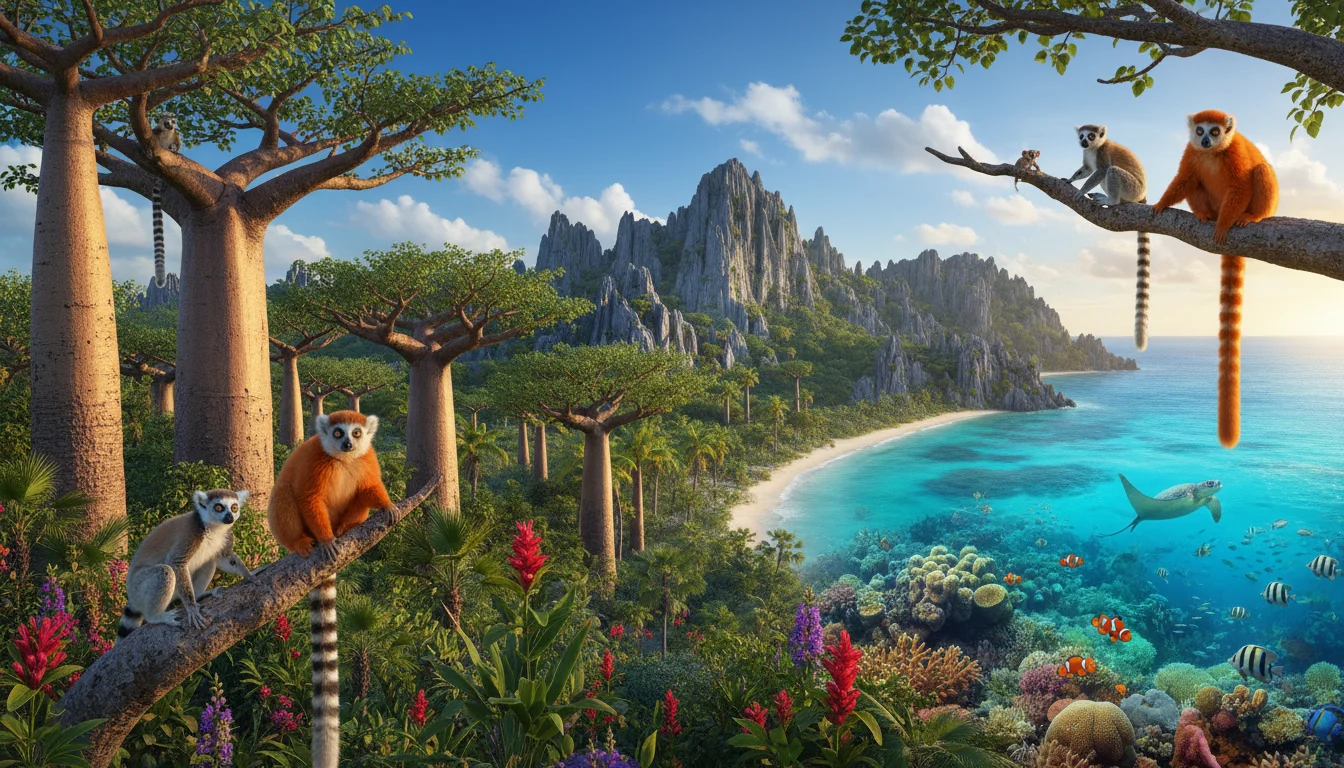

Madagascar, this mythical island in the Indian Ocean, stands out as an extraordinary destination, a veritable natural laboratory where life has taken unexpected paths. Far more than just a dot on a map, it is a world unto itself, forged by millions of years of isolation. Here, one discovers breathtaking biodiversity, landscapes that defy the imagination, and a vibrant culture rich in ancestral traditions. Every corner of the island tells a story, every path leads to a new wonder, whether it be the lush rainforests, the desert plateaus of the Red Island, or the coasts bathed by turquoise waters. Madagascar is a constant invitation to wonder, a profound immersion in a unique ecosystem and a fascinating society. A trip to Madagascar is a quest for authenticity, an exploration where every interaction, every discovery, leaves a lasting impression. Here you’ll encounter unique wildlife, of which the iconic lemurs and majestic baobabs are just the tip of the iceberg. Endemism reaches unparalleled heights, transforming every excursion into a treasure hunt for naturalists and the curious alike. It’s a land of contrasts, where the simplicity of life meets the grandeur of nature, where the smiles of the locals brighten landscapes that can sometimes be harsh. Prepare to embark on an extraordinary adventure, because the island holds surprises at every turn, and an incomparable character that sets it apart from all other destinations on the globe. It is a living testament to the power and beauty of nature. In short: 🌍 Madagascar is a global biodiversity hotspot, with an exceptional rate of endemism. 🐒 Lemurs are the undisputed stars of Malagasy wildlife, with over a hundred different species.
🌳 The island is home to seven of the nine species of baobabs. , six of which are endemic to Madagascar. 🏝️ Its geographical isolation has created a unique fauna and rare flora, found nowhere else. 🎨 Malagasy culture is a rich blend of African, Asian, and European influences, visible in its art, music, and customs. 📍 Nicknamed the Red Island for its lateritic soils, it offers strikingly diverse landscapes, from tropical rainforests to spiny deserts. 💎 Madagascar also possesses significant mineral resources, although their management presents challenges.
✈️ A trip to this island is a dynamic adventure, promising constant discoveries and memorable experiences.
- Breathtaking Biodiversity: A Unique Sanctuary in the World 🌿🐒 Madagascar stands as a living monument to nature, a veritable treasure trove of biodiversity. Its island isolation, which has lasted for over 88 million years since its separation from the African and Indian subcontinents, has shaped an unparalleled ecosystem. This unique geography has allowed evolution to follow distinct paths, creating an exceptional phenomenon of endemism. Approximately 90% of the animal and plant species found on the island are found nowhere else on Earth. This astronomical figure underscores Madagascar’s crucial importance to global science and conservation. Exploring its diverse habitats is like opening a book of untold natural histories, where each page reveals a new wonder.
- At the heart of this unique fauna are the lemurs, true symbols of the island. These primates, ancestors of monkeys and humans, have evolved into a staggering diversity of approximately 113 species and subspecies, from tiny nocturnal mouse lemurs to imposing Indris, whose melodious calls echo through the rainforests. of the East. Each lemur species has its own characteristics, feeding habits, and preferred habitats, some living exclusively in the dry forests of the West, others in the humid rainforests, and still others in the spiny areas of the South. Watching these agile creatures leap from branch to branch is an unforgettable experience, a direct immersion into living prehistory. Their presence is a key indicator of the health of Madagascar’s forest ecosystems, and their survival is intrinsically linked to the conservation of these habitats.
- But biodiversity isn’t limited to lemurs. The island is also home to an incredible variety of chameleons, geckos, and snakes, many of which display fascinating colors and shapes. Parson’s chameleon, one of the largest species in the world, lives alongside the tiny Brookesia micra, one of the smallest known reptiles. Fossas, endemic predators resembling felines, prowl the forests in search of prey, while tenrecs, small mammals resembling hedgehogs or shrews, occupy various ecological niches. Magnificent birds, such as the giant coua, and a multitude of insects with extravagant shapes and colors can also be found. Every layer of the ecosystem, from the forest floor to the canopy, teems with life, often still unknown to science. Madagascar’s rare flora is equally spectacular. The lush rainforests of the east are verdant cathedrals where exuberant orchids, giant tree ferns, and trees with precious woods flourish. In contrast, the arid southwest is home to spiny forests, a surreal landscape dominated by succulents and euphorbias with strange shapes, adapted to drought. And of course, there are the iconic baobabs.
- These majestic trees with their distinctive silhouettes, six of the world’s nine species, are endemic to Madagascar. The “bottle trees” or “trees of life” can live for thousands of years, storing water in their massive trunks, and are symbols of resilience and adaptation. The famous Avenue of the Baobabs, near Morondava, is a sight not to be missed at sunset, a moment of pure wonder. Preserving this unique natural feature is a constant challenge. Deforestation, fueled by slash-and-burn agriculture and charcoal production, threatens many habitats. Efforts are underway to create national parks and nature reserves, protecting vital sanctuaries for these unique species. Local and international initiatives are working together to raise awareness among communities and develop sustainable alternatives. Visiting Madagascar also means recognizing the urgency of these issues and the need to support responsible tourism that contributes to the conservation of this invaluable natural heritage. Every traveler becomes an ambassador for this extraordinary island and its living treasures. The richness of its biodiversity is a call to action for future generations. The Red Island and its Fascinating Giants: The World of Baobabs and Incredible Landscapes ⛰️🌳Madagascar, often nicknamed the Red Island
- Madagascar derives its evocative name from its lateritic soils rich in iron oxide, which color its landscapes a distinctive ochre hue. This natural pigment is particularly spectacular at sunrise and sunset, when the light dances across the hills and terraced rice paddies, creating panoramas worthy of paintings. The island’s geology is as varied as its biodiversity, ranging from the karst formations of the Tsingy to the high granite plateaus of the center, passing through coastal plains and volcanic massifs. This diversity of terrain is the cradle of a multitude of ecosystems and microclimates, offering a constant visual spectacle and an ever-renewing travel experience. Here, one discovers natural wonders that one would never even suspect before setting foot on the island, a testament to its unique character. Among the most emblematic features of these landscapes stand the majestic baobabs, a true symbol of Madagascar. Of the nine baobab species found in the world, six are endemic to Madagascar, making it a unique sanctuary for these “bottle trees” or “upside-down trees.” Each species has a distinct silhouette and size, from the stocky, massive trunks of the Adansonia grandidieri along the Avenue of the Baobabs to the more slender, branching forms of the Adansonia za. These ancient trees, some reaching venerable ages of over a thousand years, are true natural monuments, surviving arid climates by storing enormous quantities of water in their spongy trunks. Their presence lends an almost mystical atmosphere to the savannas and dry forests of the west, particularly around Morondava, where the Avenue of the Baobabs offers an unforgettable spectacle, especially at dusk. It is a living tableau that invites contemplation and reverence.
- The Tsingy, jagged limestone rock formations sculpted by rain erosion over millennia, represent another breathtaking geological spectacle. The Tsingy de Bemaraha National Park, a UNESCO World Heritage Site, is a labyrinth of pointed peaks where life has adapted in extraordinary ways. These stone cathedrals are traversed via suspension bridges and well-maintained paths, offering dizzying views of this lunar landscape. These formations conceal caves, canyons, and freshwater pools, home to unique plant and animal species, some of which exist nowhere else on Earth. The difficulty of accessing these areas has helped preserve their endemism and pristine beauty, offering a rare glimpse of nature in its raw state. It’s an adventure that demands a certain level of physical exertion but rewards visitors with breathtaking panoramas. Beyond the baobabs and the Tsingy, Madagascar offers a mosaic of landscapes. The rainforests of the east, such as those of Andasibe-Mantadia National Park, contrast sharply with the dry forests of the west and the spiny deserts of the south. On the central highlands, terraced rice paddies sculpt the verdant hills, reminiscent of certain Asian landscapes, while volcanic lakes add a touch of serenity. The coasts, meanwhile, boast white sand beaches fringed with coconut palms, turquoise lagoons perfect for diving, and coral reefs teeming with marine life. The island of Nosy Be, in the northwest, is a perfect example, offering idyllic settings for relaxation and underwater exploration. The diversity of the landscapes is such that one can travel from high mountains to paradise beaches in just a few days, each region offering a different atmosphere and activities. The phenomenon of the Red Island
- It is not merely aesthetic; it also reflects complex geological and climatic processes. Erosion, exacerbated by deforestation in some areas, contributes to the red color of the river water flowing into the ocean, leaving a distinctive trail. This is a constant reminder of the fragility of these ecosystems and the impact of human activities. However, the resilience of Malagasy nature is equally remarkable. Efforts are being made for reforestation and sustainable land management to preserve these unique landscapes for future generations. The vast wooded savannas, punctuated here and there by groups of solitary baobabs, evoke a forgotten Africa, where nature reigns supreme. This sense of immensity and preservation is what makes discovering Madagascar so precious and enriching for any traveler seeking authentic experiences. Sunsets over the island’s unique wildlife and landscapes will remain etched in your memory. And one never tires of contemplating the immense expanses of red earth, an indelible symbol of this exceptional land.
https://www.youtube.com/watch?v=QnB35kp3B6Q
Madagascar, Land of History and Traditions: A Dive into the Heart of Malagasy Culture 🎭🎶 Malagasy cultureMalagasy culture is a fascinating kaleidoscope of diverse influences, the result of a complex history of migrations and exchanges. Far from being monolithic, it reflects the successive arrival of populations from Southeast Asia, East Africa, as well as Arabia and Europe. These migratory waves have forged a unique identity, where ancestral traditions intertwine and enrich one another, giving rise to an incomparable cultural richness. The Malagasy language itself is living proof of these distant origins, being primarily of Malayo-Polynesian descent, with Bantu and Arabic influences. Understanding Malagasy culture is to embark on a journey through time and across continents, an exploration of the deep roots of humanity. At the heart of Malagasy culture lies a profound respect for ancestors, the “razana,” and the role they play in the daily lives of the living. This ancestor worship is manifested through numerous rituals and customs, the most emblematic of which is undoubtedly the “famadihana,” or turning of the bones. It is a festive and colorful ceremony where the bodies of the deceased are exhumed, wrapped in new shrouds, and celebrated with music, dance, and shared meals. Far from being macabre, the famadihana is a joyful celebration of life and family ties, an opportunity to strengthen the bonds between the living and the dead. These practices underscore the continuity of life and the importance of the extended family, a Malagasy characteristic that astonishes and fascinates visitors.Malagasy craftsmanship is another pillar of its culture, bearing witness to ancestral know-how passed down through generations. An incredible variety of creations can be found, from the wood carvings of the Zafimaniry people, listed as UNESCO Intangible Cultural Heritage, to the fine embroidery of the Highlands. Wild silk textiles, basketry crafted from plant fibers such as raffia and rush, and traditional musical instruments like the valiha (a tubular zither) are all testaments to the creativity and ingenuity of Malagasy artisans. Each object tells a story, each motif has a meaning, making craftsmanship far more than mere material production. The Zafimaniry villages, located in the central-eastern highlands, are renowned for their intricate wooden architecture and decorative carvings, and a visit offers an immersion into a preserved way of life. To learn more about these unique traditions, you can consult articles dedicated to zafimaniry wood from Madagascar
, revealing the depth of this art. It’s an invitation to discover the artistic soul of the island. Music and dance play a central role in Malagasy life, accompanying celebrations, rituals, and everyday moments. From the captivating rhythms of salegy on the northwest coast to the melancholic melodies of hira gasy in the Highlands, each region has its own distinct styles and instruments. Hira gasy, in particular, is a form of popular opera that combines music, dance, theater, and spoken word, often used to comment on social or political issues. These performances are true spectacles, where artists, dressed in colorful costumes, captivate their audiences with their energy and talent. Music is a vehicle for emotions, a way to share stories and keep oral traditions alive, and it contributes significantly to the dynamics of communities. Malagasy cuisine also reflects its cultural influences, blending Asian flavors (rice, ginger, coconut) with African and Creole spices. Rice is the staple food, eaten at every meal, often accompanied by “laoka,” dishes made with meat, fish, or vegetables. Spices like vanilla, cloves, and pepper, of which Madagascar is a major producer, flavor many dishes and desserts. Tasting local cuisine is exploring another facet of Malagasy culture, a sensory experience that complements the visual and auditory discoveries. Local markets are vibrant hubs of activity where you can discover the abundance of local products and the effervescence of Malagasy life. The conviviality of sharing a meal is an essential part of the Malagasy experience. It is clear that despite the challenges, traditions remain a strong pillar of society. A culinary journey as much as a cultural one awaits you on the Red Island. The Challenges and Potential of the Malagasy Economy: Between Natural Resources and a Sustainable Future 📈💎 Madagascar’s economy, despite its immense natural wealth and unique biodiversity, faces significant structural challenges. However, it also possesses considerable growth potential, particularly in key sectors such as agriculture, mining, tourism, and handicrafts. The island boasts abundant natural resources, from fertile lands ideal for growing rice, spices, and fruits, to subsoil rich in precious minerals and energy. Managing these resources, in balance with the need to preserve its fragile ecosystems, is central to the nation’s sustainable development goals. This presents both immense opportunities and significant responsibilities in protecting its unique environment. The agricultural sector is the cornerstone of the Malagasy economy, employing a large portion of the population and contributing significantly to GDP. Madagascar is world-renowned for its production of vanilla, cloves, coffee, and lychees. Vanilla, in particular, is a leading export, and the island produces a large portion of the top-quality Bourbon vanilla. Developing more integrated value chains and improving the processing of agricultural products would increase producers’ incomes and ensure greater economic stability. Efforts to improve agricultural techniques and access to international markets are crucial. This sector has great potential to improve the living conditions of millions of people, especially considering the rainforests and arable land. Madagascar’s mineral resources are vast and varied, including precious stones (sapphires, rubies), strategic minerals (graphite, ilmenite, chromite), and metals. Mining represents a significant source of revenue, but it also raises environmental and social concerns. Establishing a strict and transparent regulatory framework is essential to ensure responsible mining that benefits local communities and the country as a whole, while minimizing the impact on ecosystems. Regular discussions on the impact of a mining moratorium in Madagascar and the management of mineral resources are important for the future of this sector. Ensuring the traceability and legality of operations is a priority. Developing these resources is a major driver of growth, if carried out wisely and with foresight.
Key Economic Sectors of Madagascar Search Reset Filter
No results found for your search. Did you know? Facts about Madagascar! Loading interesting facts… Tourism, focused onecotourism
and the discovery of the island’s unique fauna and rare flora , offers considerable development potential. The lemurs
, the
baobabsand the landscapes of theRed Island attract visitors from all over the world. Developing environmentally friendly tourism infrastructure, training local stakeholders, and promoting sustainable tourism are essential to maximizing economic benefits for local communities while protecting natural sites. The island must capitalize on itsuniqueness
to position itself as a unique destination. Investments in hotels and services are needed to accommodate a growing number of travelers seeking authentic adventures and memorable experiences, particularly those related to the Discover paradise islands like Nosy Be. Energy infrastructure, while still limited, is showing signs of progress. The development of renewable energy projects, such as solar power plants, is an important step towards electrifying the country and reducing dependence on fossil fuels. The construction of the Moramanga solar power plant, for example, is an encouraging sign of efforts to modernize the electricity grid and support economic development. For more information, see the Moramanga solar power plant website. Improving transport infrastructure, from roads to ports, is also crucial to facilitating domestic and international trade and enabling Malagasy products to reach global markets more efficiently. Madagascar needs to strengthen its resilience to climate events, such as cyclones, which can severely impact infrastructure and agriculture. The devastation caused by Cyclone Fytia at the beginning of 2026 is a stark reminder of the urgent need for climate change adaptation. Economic diversification, good governance, and the fight against corruption are fundamental to unlocking the island’s full potential and ensuring a prosperous future for its people, while protecting its rich biodiversity and Malagasy culture. It’s a complex but promising path for this island nation.
https://www.youtube.com/watch?v=dCHj4ATAM6U Adventure and Discovery: Unforgettable Itineraries and Travel Experiences in Madagascar ✈️🗺️ Embarking on an adventure in Madagascar means opening yourself up to a world of intense discoveries and diverse experiences, a journey that goes far beyond simple sightseeing. The island offers a multitude of itineraries, each revealing a different facet of its unique natural and cultural character. Whether you’re a fan of hiking, diving, wildlife, or culture, there’s an ideal route for every traveler, promising unforgettable memories. Planning a trip to Madagascar requires some preparation, but the rewards are immense, as it offers a unique sense of exploration. It’s a destination that invites you to venture off the beaten path and embrace the unexpected. For nature and biodiversity lovers, a classic itinerary might begin in the rainforests of the east, such as Andasibe-Mantadia National Park. Here, you can marvel at the Indri, the largest of the lemurs, whose calls echo through the forest at sunrise—a truly mystical experience. Local guides, often from the surrounding communities, share their deep knowledge of the flora and fauna, allowing you to get close to these fascinating creatures in their natural habitat. Continuing south, you’ll discover desert landscapes and the famous baobabs, including the iconic Avenue of the Baobabs near Morondava, an absolutely magical site at sunset. This immersion in nature is a lesson in humility and wonder at the power of evolution, and an opportunity to observe unique wildlife in action.
The central highlands offer a different perspective of the island, with their terraced rice paddies, traditional brick houses, and bustling markets. Antananarivo, the capital, is a starting point for exploring historical and cultural sites, such as the Queen’s Palace or the Rova of Ambohimanga. Further south, National Route 7 is a true backbone, traversing diverse landscapes from Analamazoatra to Ranomafana, another national park renowned for its diurnal and nocturnal lemurs and its rare flora. The landscapes change dramatically as you head south, where you’ll find Isalo National Park, a sandstone massif sculpted by erosion, offering canyons, natural pools, and breathtaking panoramas. It’s a hiker’s paradise, with trails suitable for all levels and opportunities to camp under the stars. Here, the Red Island reveals its most intense colors. For those who love relaxation and water sports, Madagascar’s coasts are brimming with treasures. Nosy Be, in the northwest, is the quintessential beach destination, with its fine sandy beaches, crystal-clear waters ideal for diving and snorkeling, and lively atmosphere. The surrounding islets, such as Nosy Komba (Lemur Island) or Nosy Tanikely (a marine reserve), offer memorable excursions. Further south, Ifaty and Anakao, near Tulear, are Vezo fishing villages where you can live to the rhythm of outrigger canoes, explore coral reefs, and observe humpback whales (from July to October). These maritime experiences perfectly complement land-based explorations, offering a comprehensive view of Madagascar’s diversity. Underwater life is as rich and colorful as that on land, another aspect of the islands’ endemism. Some practical tips for a successful trip: 🗺️ Renting a 4×4 vehicle with a driver is often recommended for exploring the sometimes challenging roads in the interior. 🦟 Don’t forget good mosquito repellent and a first-aid kit. 🤝 Respecting Malagasy culture and local customs will greatly enrich your experience. Learn a few words of Malagasy; the locals will appreciate it! 🍲 Savor the local cuisine, from zebu kebabs to fresh exotic fruits—it’s a delight for the taste buds. 💰 Bring local currency, the Ariary, as credit cards are not accepted everywhere. Finally, be flexible: schedules can be approximate, and unexpected events are part of the Malagasy adventure. A trip to Madagascar is a profound immersion, a true expedition that leaves a lasting impression on the mind and heart. This is an opportunity to disconnect from everyday life and reconnect with authentic nature and culture. Every interaction and discovery will remind you of the unique character and richness of this extraordinary island. You’ll discover a unique sense of hospitality and breathtaking landscapes at every turn.
What makes Madagascar’s biodiversity so special?Madagascar is a biodiversity hotspot thanks to its prolonged island isolation, which has allowed its flora and fauna to evolve in unique ways. More than 90% of its species are endemic, meaning they are found nowhere else on Earth, such as lemurs and baobabs. Why is Madagascar called the Red Island? The island is nicknamed the Red Island because of its lateritic soils rich in iron oxide, which give the landscapes a distinctive ochre hue. This phenomenon is particularly visible in the Highlands and Southern regions, and is exacerbated by erosion. What are the emblematic species of Madagascar? The most iconic species are undoubtedly the lemurs, with over a hundred species, and the baobabs, six of the nine global species of which are endemic to the island. Unique chameleons, fossas, and a very diverse flora are also found there.
Ancestor worship, or ‘razana’, is central to Malagasy culture. It is manifested by a deep respect for the deceased, considered intermediaries between the living and the divine. Rituals such as the famadihana (turning of the bones) illustrate this continuous connection between generations.
How to travel responsibly in Madagascar? To travel responsibly, it is recommended to support local tourism, hire local guides, respect the environment by leaving no trace, respect local customs and traditions (fady), and prioritize accommodations and activities that promote sustainable development and conservation.
Découvrez notre guide complet — destinations, budget, visa, faune et conseils pratiques pour préparer votre voyage.

📖 Vous aimerez aussi

Transition à Madagascar : la société civile et la Génération Z face aux doutes sur le « Programme de la Refondation »
3 March 2026
Fermeture de l’aéroport de Dubaï : chaos et désarroi chez les voyageurs bloqués
2 March 2026


