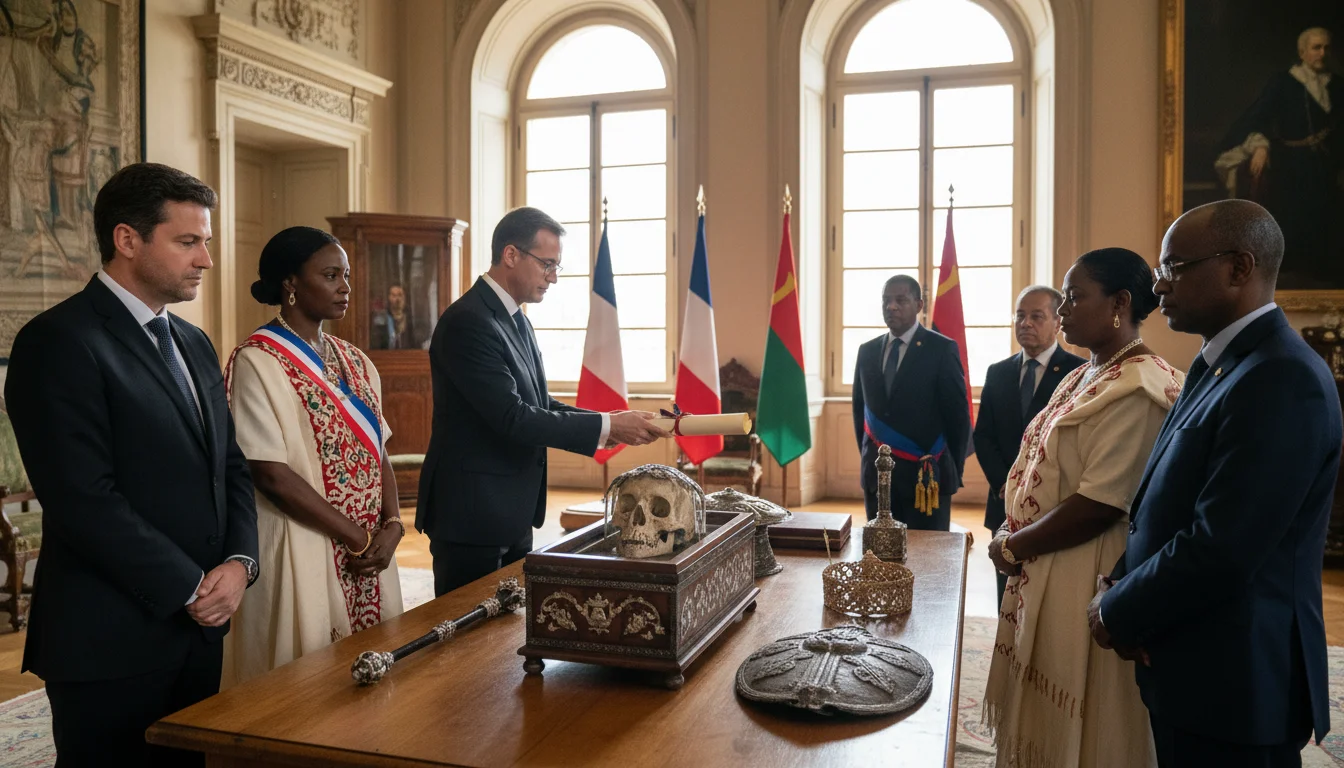

A major chapter in history is being written between France and Madagascar, a powerful gesture of recognition and reconciliation that resonates far beyond their borders. August 26, 2025, will be etched in history as the date of the return of emblematic royal relics, including the skull of King Toera, a revered figure of the Malagasy resistance. This act, awaited for decades, is much more than a simple transaction; it is a vibrant tribute to a national hero, a crucial step in repairing a cultural and memorial heritage torn apart by the colonial past. This initiative, the result of a long process of identification and dialogue, paves the way for a new era of cooperation, where culture and the memory of peoples regain their rightful place. This transfer of ownership, made possible by a groundbreaking French law of 2023, marks a turning point for public collections and the way history is approached. It is a unique opportunity to see how science and ancestral traditions can converge to honor the past and build a shared future, even if the path is fraught with obstacles and complex dynastic issues. The symbolism of this return is powerful, offering a people the chance to restore full dignity to one of their most illustrious ancestors. In short: ✈️ France returned three Sakalava skulls to Madagascar, including that of King Toera, on August 26, 2025.📜 This gesture constitutes the first application of the 2023 French law facilitating the removal of human remains from public collections. 👑 The skull of King Toera, decapitated in 1897 by colonial troops, is a powerfulsymbol of resistance for the Malagasy people. 🔍 A hybrid process combining historical investigations, uncertain DNA tests, and ritual recognition by descendants enabled the identification.🏛️ The remains were kept at the Musée de l’Homme in Paris, among nearly 400 other Malagasy human remains. 🌍 The restitution is an essential act of
tribute,
- redressing a part of colonial history and restoring cultural heritage to Madagascar. 🤝 Internal disagreements within the Malagasy royal family complicated the reception of these relics, illustrating significant power struggles. A Historic Moment: The Restitution of Royal Relics to Madagascar, a Delayed TributeAugust 26, 2025, will remain a date etched in the memories of both nations,
- France
- and Madagascar,marking a historic and profoundly human turning point. On that day, France officially returned three human skulls to Madagascar, dating from the colonial conquest period. Among them is the skull that descendants and tradition attribute to King Toera, an emblematic figure of the Sakalava resistance. This event is not merely an administrative transaction; it is a meaningful act of restitution, a recognition of history, and a step toward healing the wounds of the past. For the inhabitants of Madagascar, it is a powerful tribute to one of their national heroes, whose memory has remained vivid despite the passing decades. The impact of this action is immense, not only diplomatically, but also culturally and in terms of memory, for the communities involved, and more broadly for the entire Malagasy people, who see a part of their heritage and identity returned to the country. This symbolic moment was the result of lengthy negotiations and a complex process, illustrating the desire of both nations to build a relationship based on respect and mutual understanding, far removed from past tensions. This restitution is all the more significant as it constitutes the very first concrete application of the French law adopted in December 2023. This groundbreaking legislation aims to facilitate the removal of human remains from French public collections, particularly those acquired in violent colonial contexts and whose preservation is deemed an affront to human dignity. It was a true legislative breakthrough, recognizing the need to deviate from the rule of inalienability that protects museum collections. The decree formalizing the transfer of ownership to the Republic of Madagascar was signed on April 2, 2025, thus fulfilling a request made by Antananarivo as early as 2022. It is fascinating to see how the legal framework can evolve to address such profound ethical and moral issues. This demonstrates a growing awareness of historical responsibilities and a commitment to a more just cultural diplomacy. The involvement of a Franco-Malagasy scientific committee, established in October 2024, was crucial to this process. It brought together experts from both countries, but also, and this is a key point, two representatives of the Sakalava royal descendants. Their presence allowed for the integration of oral traditions as fully-fledged historical sources, offering an enriching perspective that respects local customs—essential for such a delicate and sacred undertaking.
- The recognition of these traditional voices
- is a remarkable step forward, signaling a paradigm shift in the management of
- royal relics and colonial legacies. The committee’s final report, submitted in January 2025, concluded that the three skulls fell fully within the scope of the law on the repatriation of human remains. This decision goes beyond scientific considerations to encompass profound ethical and cultural aspects. It is not simply about returning objects, but about restoring dignity. Imagine the emotion for the descendants to see these relics of their ancestors, considered sacred, return to their homeland after more than a century. This is a tremendous step for the collective memory of Madagascar, allowing a painful chapter of history to close and reaffirming the country’s cultural sovereignty. Through this act, France sends a strong signal to the rest of the world regarding its commitment to revisiting its colonial past and working towards genuine reconciliation. It is an example of how nations can, with time and political will, transform historical wounds into opportunities for dialogue and cooperation. This is truly a wonderful gesture that invites reflection on the role of museums and public collections in the preservation and restitution of the heritage of peoples. This process, while complex, offers a model for other nations facing similar demands, demonstrating that it is possible to reconcile scientific, legal, and cultural requirements. The restitution of King Toera’s skull is therefore much more than a historical anecdote; it is a pivotal event for international relations and the recognition of memorial rights.King Toera: A Symbol of Resistance and National Pride in Madagascar At the heart of this historic restitution lies the emblematic figure of King Toera, whose presumed skull has become a powerful symbol for an entire people. For Madagascar King Toera is not just a ruler of the past; he embodies the indomitable spirit of resistance against colonial oppression. His story is that of a chief of the Menabe kingdom in western Madagascar who refused to submit to French military force at the end of the 19th century. His courage and selflessness made him a true national hero, whose name is whispered with respect and pride in oral traditions. French colonization, which began in 1895, was a period of violence and profound upheaval for Malagasy communities. French troops waged bloody campaigns to subdue independent kingdoms, and Menabe was not spared. The massacre at Ambiky in 1897, the Sakalava royal capital, was a particularly brutal episode, in which many warriors, including King Toera himself, were killed. The decapitation of Toera, and the fact that his skull was taken as a trophy, is a deep wound in the Malagasy collective memory, symbolizing the dehumanization and desecration inflicted by the colonizer. The restitution of this royal relic is therefore an act of memorial justice, restoring to Toera and all those who resisted their full dignity. It is a moment of reflection and celebration, where intangible heritage takes on a tangible and emotional dimension, reinforcing Malagasy identity and culture. The story of Toera is a recurring theme in the history of resistance. His actions are part of a series of uprisings against foreign invasion, and his bravery is celebrated across generations. He was the last independent ruler of the Menabe kingdom, and his fall marked the end of an era of autonomy for this part of Madagascar. Oral chronicles, passed down orally, recount the challenges he faced and the strategies he employed to defend his people and his lands. Although French colonial archives are often incomplete regarding the details of war trophies, the importance accorded to the king’s skull by Malagasy tradition underscores the psychological and spiritual impact of its capture. In a society where ancestor worship is a fundamental value shared by all, the deprivation of a king’s body, and particularly his skull, is an intolerable affront to the cosmic order and dynastic continuity. The skull is not merely a skeletal remnant; it is the seat of the spirit, wisdom, and ancestral power. Its presence on French soil, preserved in a museum’s reserves, was a permanent insult to the dignity of the king and his people. The pain felt by the descendants
is palpable, expressing this sense of indignity at the decontextualization and preservation of such a
sacred symbol. Imagine the weight of this waiting, the perseverance of the royal families and historians to ensure that justice is done for this revered ancestor. It is truly a poignant story of perseverance. Therestitution of King Toera’sskull is therefore an event that goes far beyond the simple handover of an object. It is a recognition of history, of past suffering, and an act of symbolic reparation that allows an entire people to reclaim an essential part of their identity. The official ceremony, even if it was a source of internal tensions, as we shall see, is a moment of jubilation and profound respect. It offers the opportunity to reintegrate these royal relics into their ritual and spiritual context, to honor them according to ancestral customs. For the younger generations of Malagasy, the return of King Toera is a powerful reminder of their history, the resilience of their ancestors, and the importance of preserving their culture and heritage. It is a catalyst for education, research, and the transmission of traditional knowledge. The skull of King Toera, returning to its homeland, once again becomes a pillar of Malagasy identity, a guardian ancestor who continues to inspire. It is a joy to see such a symbol regain its rightful place, reaffirming that history cannot be locked away indefinitely. This return marks a decisive step in Madagascar’s quest for cultural and spiritual self-determination, a remarkable act that reminds us of the importance of every gesture in the grand narrative of a people’s history. https://www.youtube.com/watch?v=TCiZeEXryM8The Long Road to Identification: Between Science, Ritual, and the Quest for Truth for the Royal Relics The journey leading to the restitution
of the royal relics to Madagascar , and in particular the skull of King Toera , has been a true voyage through time, blending rigorous scientific investigations with ritual recognition by descendants. This long and complex identification process began well before the promulgation of the 2023 law. As early as 2003, an initial request for restitution was made, a sign of the perseverance of the Malagasy communities. It was historian Klara Boyer-Rossol who, starting in 2004, undertook to collect the first testimonies from the descendants of the Sakalava kings in western Madagascar, conducting some fifteen years of assiduous research, always in close dialogue with the royal families. Her work was essential in untangling the threads of a history often obscured by colonial archives, and in tracing the path of these relics.
in French collections. The Musée de l’Homme in Paris, for example, houses nearly 400 skulls and other human remains of Malagasy origin, a figure that testifies to the scale of the collections made during the colonial period. It is easy to imagine the difficulty of this quest, almost like that of a detective searching through the dusty shelves of history and museum displays, looking for a symbol among so many others. It truly was a Herculean task that was undertaken for this essential recognition. Klara Boyer-Rossol’s research made it possible to identify three skulls specifically linked to the colonial conquest of Menabe at the end of the 19th century. Two of them could be clearly linked to Sakalava warriors killed in March 1898 by the French army, anonymous individuals who today rediscover a part of their identity. The third skull, however, underwent extensive historical and biological investigations to determine if it could be that of King Toera. The research revealed a crucial element: these three skulls had been brought back by Guillaume Grandidier, the only known collector of human remains during the armed conquest of Menabe. This information, although circumstantial, constituted very strong indirect evidence. “If King Toera’s skull was indeed taken and placed in a French museum, there is a very high probability that it belonged to this collector. There is no other known example, at least not yet,” emphasized Klara Boyer-Rossol. It was on the basis of these converging clues, and at the urgent request of the descendants, that a DNA identification process was launched between 2018 and 2022. The objective was to compare the DNA of the suspected skull with that of royal bones transported from western Madagascar. The remains were then transported to the Musée de l’Homme in Paris. Initial results showed consistency in terms of sex and estimated age, which was a promising start, but unfortunately, the insufficient quality of the DNA in the royal bones prevented formal and irrefutable confirmation. This illustrates how delicate these investigations can be and how subject they are to the vagaries of time and preservation—a true race against time for the truth. Faced with scientific uncertainty, another, equally crucial, form of identification came into play: ritual recognition. In late 2021, Sakalava descendants conducted an ancestral process, steeped in spirituality and tradition, to determine the skull’s authenticity. Through this rite, they formally recognized the third skull as that of their king. Similarly, the other two skulls were identified as belonging to Sakalava warriors. Thus, where science reached its limits, culture and faith provided certainty, effectively granting the skull the status of a sacred relic. Klara Boyer-Rossol emphasizes this hybrid approach: “Ultimately, the identification process is a hybrid one: scientific, but also cultural and religious. If King Toera’s skull had been scientifically identified but his descendants hadn’t recognized it, there would have been no demand for its restitution.” This statement underscores the paramount importance of the consent and recognition of the communities involved. This is a truly brilliant point, as it demonstrates that truth can take many forms and that respect for traditions is essential. Ritual recognition holds undeniable authority for the communities that possess it, and without it, restitution would have lost much of its meaning. This process teaches us that heritageIt is not limited to material facts, but is also deeply rooted in the spiritual and the immaterial. It is a beautiful lesson in wisdom and humility that is offered to us, demonstrating that the quest for truth is sometimes a multifaceted journey. Chronology: Homage and Restitution of Malagasy Relics French Colonial Collections: A Heritage to Reassess and the Challenges of Restituting King Toera’s Skull The
restitution
of King Toera’s skull and those of two other Sakalava warriors highlights a broader and profoundly ethical question: that of the presence of vast collections of human remains in French and, more broadly, European museums. These collections, often acquired in violent colonial contexts, tell a complex story of conquest, plunder, and dehumanization. Colonial archival sources are unfortunately disconcertingly opaque and often incomplete when it comes to documenting the practices of collecting skulls or severed heads. Yet, these practices were commonplace within colonial empires, whether French, British, or Portuguese, and were an integral part of a logic of domination and racial “science.” The Musée de l’Homme in Paris, with its nearly 400 skulls and human remains from Madagascar alone, is a striking testament to the scale of these collections, which continued throughout the colonial period. This is a historical reality whose full significance must be grasped, because these objects are not simply museum pieces; they carry within them individual and collective histories of suffering and dispossession. Recognizing this reality is a crucial step for any process of reconciliation and reparation, demonstrating the extent to which colonial history continues to impact our perception of heritage. Klara Boyer-Rossol, a historian involved in the case, explains that while acquisitions from battlefields, such as that of King Toera’s skull, were emblematic, they were actually in the minority compared to other methods of collection. The looting of graves, whether ancient or recent, archaeological excavations conducted without the consent of local populations, and sometimes even removals from colonial hospitals, constituted the main sources of these collections. This method of acquisition, without the consent of individuals and their descendants, in contexts of physical, moral, or political violence, is deeply problematic and calls into question the legitimacy of their preservation. In the specific case of Madagascar, this issue is all the more sensitive because ancestor worship represents a fundamental value, shared by the entire society. An ancestor, whether king or simple warrior, must rest on his land, surrounded by his descendants, so that his spirit continues to watch over the clan. The fact that royal relics are kept in cardboard boxes on museum storage shelves is perceived as an intolerable affront to human and spiritual dignity. “Recognized as their ancestor, who, moreover, is the last Sakalava king of Menabe, it is indeed utterly undignified for them that he be kept in a cardboard box on a shelf in the reserves of the Musée de l’Homme, just like the soldiers, even if they are not of royal blood,” the historian adds. This feeling of indignity is at the heart of the demands for restitution and underscores the importance of this gesture for Malagasy culture. It is extremely important to understand this profound dimension. With the restitution decree signed, France has committed to returning the three Sakalava skulls to Madagascar.within a year. However, this return, while symbolically triumphant, has not been without tension. The official ceremony, initially scheduled for April 14, 2025, had to be postponed until August at the request of President Andry Rajoelina. The reason? Internal dissension among the descendants of the royal family. These divisions, which have always existed but have intensified since the death last year of the traditional king, Magloire Kamamy, have ushered in a period of mourning and a power vacuum that has exacerbated the competition between the heirs. The stakes are enormous: whoever possesses the relic of King Toera will, in effect, have greater legitimacy to claim the throne of Menabe. Klara Boyer-Rossol explains this complex situation: “The power struggles are enormous, since whoever possesses the relic will have the throne of Menabe.” “This situation illustrates the complexity of cultural heritage returns, which are not simply administrative acts, but events that can disrupt the political and social balance within the communities of origin. It is a true lesson in the need to meticulously prepare these restitutions, taking into account all sensitivities. This initial process of identification and restitution, within the framework of the 2023 law, also highlights the urgent need to better document collections of human remains in French museums. “It is a French public heritage that is currently kept in the shadows of museum storage, except that this form of invisibility keeps them in a state of opacity and ignorance of their history,” laments the historian. It is crucial that these stories are finally told and that this heritage It is back in the spotlight, not only for the countries of origin, but also for a better understanding of our shared history. It would be wonderful to have more transparency about these collections and their provenance. The complexity of returning relics should not be discouraging, but rather encourage better preparation and ongoing dialogue. https://www.youtube.com/watch?v=tQbd7UprN3AThe Legacy of a Gesture: Repairing History and Building the Future between France and Madagascar The return of royal relics to Madagascar, and particularly the skull of King Toera, is not an end in itself, but the beginning of a new chapter, rich in lessons and challenges. This historic gesture, undertaken by France in August 2025, represents much more than a simple transaction of objects; This is a profound act of historical reparation, a tribute to the dignity and resilience of a people. For Madagascar, the return of these symbols of resistance offers an invaluable opportunity to reaffirm its identity, strengthen national cohesion around iconic figures like King Toera, and heal colonial wounds that have bled for far too long. It is an essential step towards reconciliation, not only between the two nations, but also within Malagasy communities themselves, who are reclaiming a part of their heritage and collective memory. This process compels us to reconsider the place of history and culture in our societies, and to recognize that the past, far from being static, continues to shape the present and influence the future. The joy of seeing such a gesture come to fruition is immense, and it is truly an opportunity not to be missed if we are to understand the challenges of today. The dialogue initiated betweenFrance and Madagascar regarding the issue of royal relics This can serve as a model for other nations facing similar colonial legacies. The 2023 French law that made this restitution possible is a powerful instrument that marks a significant shift in how states can address their past and the responsibilities that come with it. It paves the way for further restitutions, encouraging better documentation and greater transparency of ethnographic and anthropological collections. The example of the King Toera skull
shows that the identification process cannot be solely scientific; it must absolutely integrate the cultural and ritual dimensions of the communities of origin. This hybrid approach, where oral traditions carry as much weight as DNA analysis, is a lesson in humility and intercultural respect. It demonstrates that truth and legitimacy do not always reside solely in tangible evidence, but also in symbolic and spiritual recognition. It is wonderful to see this convergence of approaches toward a just and equitable outcome. This approach contributes to decolonizing not only museums, but also mindsets, by encouraging a more shared and polyphonic vision of heritage history—a true cultural revolution. However, the path to full reconciliation is fraught with obstacles. Disagreements within the Malagasy royal family regarding who will receive the relics of King Toera serve as a reminder that power dynamics and internal traditions are complex and cannot be ignored. The management of these relics, once returned to Madagascar, will require great wisdom and transparent governance to prevent this symbol of unity from becoming a source of division. It is crucial that these royal relics may they be received and honored with respect for customs, and may they contribute to strengthening the sense of belonging and national pride. The future of these remains, their preservation, their possible exhibition, and their role in rituals must be defined collectively by the descendants and the Malagasy authorities. France, for its part, through this gesture of homage, is embarking on a path of recognition and ongoing dialogue that goes beyond mere material restitution. It is an invitation to rethink post-colonial relations, to build partnerships based on equality and mutual respect. This story of
King Toera’s skull is therefore not just a historical anecdote; it is a powerful call for justice, for the recognition of cultures, and for building a shared future, a future where everyone’s heritage is honored. Key Stage Approximate Date Actors Involved Main Impact Emoji Ambiky Massacre and Death of King Toera 1897 French colonial troops, King Toera, Sakalava warriors Beheading of King Toera, removal of skulls as trophies. ⚔️ First Request for Restitution 2003 Sakalava royal descendants, Malagasy StateOfficial start of the quest for the relics.
🗣️ Historical Research and Testimonies
2004 – 2018 Klara Boyer-Rossol, Sakalava royal descendants Identification of provenance and historical links. 🔍 DNA Identification Process 2018 – 2022French and Malagasy scientific experts Attempt at formal confirmation of the skulls’ identity. 🧬 Ritual Recognition of SkullsLate 2021 Sakalava Royal Descendants Spiritual and cultural confirmation of identity. 🙏 Adoption of the French Restitution Law
December 2023 French ParliamentLegal framework for the removal of human remains from public collections. ⚖️ Decree of Transfer of Ownership
April 2, 2025 French Government Official restitution to Madagascar. 📄 Ceremony for the Return of Relics August 26, 2025 French and Malagasy Officials, Royal Descendants A historic act of homage and reconciliation.
🎉 What royal relics were returned by France to Madagascar?
France returned three human skulls. Among them is the presumed skull of King Toera, an emblematic figure of Malagasy resistance, as well as the skulls of two other Sakalava warriors. These restitutions carry a strong symbolic weight of homage and recognition of Malagasy heritage. Why is the return of King Toera’s skull so important for Madagascar? King Toera is considered a true national hero in Madagascar, having valiantly resisted the French colonial conquest at the end of the 19th century. His skull, taken as a trophy, represented a deep-seated wound to the nation’s memory. Its restitution is an act of reparation, restoring dignity to a revered ancestor and reinforcing Malagasy identity and culture, which are particularly sensitive to ancestor worship. What role did the 2023 French law play in this restitution process?
The 2023 French law is essential because it created a legal framework allowing for exceptions to the principle of the inalienability of public collections, thus facilitating the removal of human remains acquired in violent colonial contexts. This law made possible the restitutionof royal relics toMadagascar , marking an important step in the recognition of France’s historical responsibilities. How was the identification of King Toera’s skull carried out? The identification of King Toera’s skull It was a hybrid process. It involved extensive historical research by historian Klara Boyer-Rossol and attempts at DNA analysis. However, due to insufficient DNA quality, formal confirmation was not obtained. Ultimately, it was the ritual recognition by the Sakalava royal descendants that formally recognized the skull as that of their king, conferring upon it its status as a relic.
What are the implications of this restitution for relations between France and Madagascar? This restitution is a powerful act of reconciliation and dialogue between France and Madagascar. It symbolizes a new era of cooperation based on mutual respect and recognition of cultural and historical heritage. It paves the way for further discussions on the colonial past and the management of museum collections, strengthening diplomatic and cultural ties between the two nations.
Découvrez notre guide complet — destinations, budget, visa, faune et conseils pratiques pour préparer votre voyage.

📖 Vous aimerez aussi

Transition à Madagascar : la société civile et la Génération Z face aux doutes sur le « Programme de la Refondation »
3 March 2026
Fermeture de l’aéroport de Dubaï : chaos et désarroi chez les voyageurs bloqués
2 March 2026